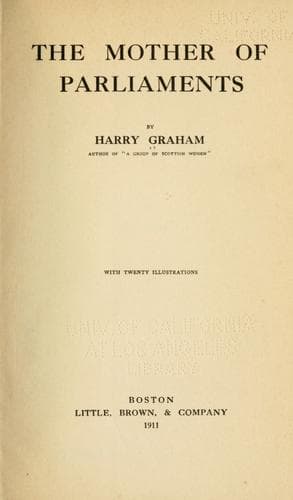
Great Britain. Parliament; Great Britain. Parliament -- History; Representative government and representation
In spite, however, of the many efforts which have been made to
accelerate business, the parliamentary machine moves but slowly, and
the time spent in discussing any measure to which there is active,
sincere, and persistent opposition shows no signs of diminishing in
length. Thus, while the Home Rule Bill of 1893 required 180 divisions,
the Education Bill of 1902 required 295; and over the Finance Bill of
1909 Parliament spent something like 73 days (or 740 hours) and
divided no less than 420 times.
CHAPTER X
PARLIAMENTARY PRIVILEGE AND PUNISHMENT
Parliament has ever been most tenacious of its historic and
traditionary rights and privileges. Of these, freedom of speech and
freedom from arrest may be considered the most important. The right of
personal access to the Crown is claimed by peers, any one of whom may
demand a private audience with the sovereign, and, though the Commons
are not granted a similar privilege, it is permissible for them to
accompany their Speaker when he presents an address to the King, and
to wear ordinary dress on such an occasion.
In olden days peers enjoyed other indulgences denied to their humbler
brethren. They were, for instance, permitted to kill deer in the
King's forests whenever, in obedience to a royal summons, they
journeyed to or from the sovereign. At such times the bag was limited
to two deer, and these might only be slain in the presence of the
King's Forester. If that official were not at hand, the sporting peer
was enjoined to blow several loud blasts upon his hunting-horn before
pursuing his quarry to the death.[256] Peers were further allowed
"benefit of clergy," in the good old days, for such crimes as highway
robbery, horse-stealing and house-breaking, but only for a first
offence. If they took up burglary as a hobby, or if the robbery of
churches became with them a daily habit, they could no longer escape
from the consequences of their misdeeds, and were haled to prison just
as though they had been mere ordinary mortals. "Benefit of clergy"
was a privilege which was repealed by Act of Parliament in 1801, and a
peer to-day cannot steal a single gold watch with impunity.
[256] Pike's "Constitutional History," p. 267.
Public-domain text, read in full here on John Shaqi.
Reviews
Reviews
No reviews yet
Be the first to share your thoughts on this work.
Elsewhere in the archive
Join the Discussion
Join the discussion
Sign in to leave a comment or review.
Sign InorCreate an account