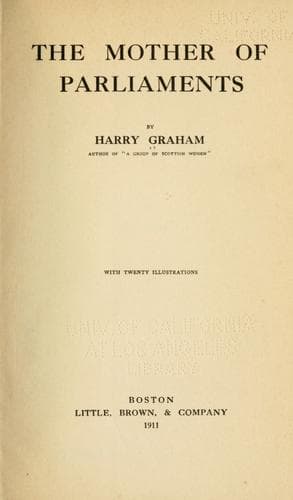
Great Britain. Parliament; Great Britain. Parliament -- History; Representative government and representation
Occasionally, however, political differences have been the cause of
ruptured friendship. When Burke made a violent attack upon Fox, in
1791, on the Canada Bill, he declared that if necessary he would risk
the latter's lifelong friendship by his firm and steady adherence to
the British Constitution. Fox leaned across and whispered that there
was no loss of friends. "Yes," replied Burke, "there _is_ a loss of
friends. I know the price of my conduct. I have done my duty at the
price of my friend. Our friendship is at an end!" So terminated an
intimacy of twenty-five years' standing. Such an incident may,
nevertheless, be considered exceptional, the relations of antagonists
being usually of a most harmonious kind. Sir Robert Peel and Lord John
Russell would often be seen together engaged in friendly conversation.
O'Connell once walked arm in arm down Whitehall with Hughes Hughes,
the member for Oxford, whose head he had but recently likened to that
of a calf.[35] And the present Prime Minister and Leader of the
Opposition are doubtless able to play bridge or golf together without
actually coming to blows. In spite, therefore, of much criticism, what
Emerson calls "that capital invention of freedom, a constitutional
opposition,"[36] has been found to be the most practical and
satisfactory means of carrying on government.
[32] See Parr's "Discourse on Education," p. 51.
[33] "Anecdotes and other miscellaneous pieces" left by the Rt. Hon.
Arthur Onslow. (From the MS. at Clandon.)
[34] This saying has often been wrongly attributed to Lord Randolph
Churchill. That statesman's most famous maxim on the subject of
Opposition is given in his son's "Life" (p. 188-9): "Whenever by an
unfortunate occurrence of circumstances an Opposition is compelled to
support the Government," said Lord Randolph, "the support should be
given with a kick and not with a caress, and should be withdrawn on
the first available moment."
[35] This was evidently a favourite simile of O'Connell's. He used it
again with reference to Mr. Shaw, member for Dublin University, in the
debate on the resolution for giving a grant to Maynooth College for
the education of Roman Catholics.
[36] "English Traits," p. 46.
CHAPTER II
THE HOUSE OF LORDS
No constitutional principle has been so strongly criticised and so
freely abused as the one embodied in the hereditary chamber which
forms so important a branch of our legislature. Pulteney labelled the
House of Lords a "hospital for invalids"; Burke contemptuously
referred to it as "the weakest part of the Constitution"; Lord
Rosebery has compared it to "a mediæval barque stranded in the tideway
of the nineteenth century." A more democratic modern statesman, who
doubtless hopes--
"To build, not boast, a generous race;
No tenth transmitter of a foolish face,"
Public-domain text, read in full here on John Shaqi.
Reviews
Reviews
No reviews yet
Be the first to share your thoughts on this work.
Join the Discussion
Join the discussion
Sign in to leave a comment or review.
Sign InorCreate an account