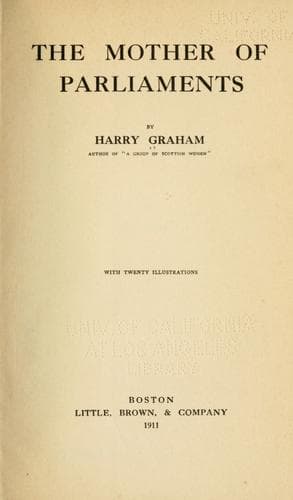
Great Britain. Parliament; Great Britain. Parliament -- History; Representative government and representation
A hundred years ago the path of the Pressman was not so smooth as it
is to-day. Up to 1840 the publication of debates was undertaken at the
risk of the printer. In that year Hansard published the report of a
Select Committee of the House of Commons, in which a certain book was
referred to as "disgusting and obscene." Stockdale, the publisher of
the book in question, took the matter into Court and obtained £600
damages for libel. The House retorted by summoning to the bar the
Sheriffs of Middlesex who had tried the case, and reprimanded them for
their contempt of its privileges. After this Lord John Russell took
the first opportunity of introducing a Bill rendering all publication
of speeches and documents, if by the authority of Parliament, matters
of privilege not amenable to ordinary law. A member of Parliament
cannot, however, claim privilege for publishing or circulating the
report of any libellous speech made in the House, though he is, of
course, protected there for anything he may say. The suggestion that
privilege of Parliament should protect members from being proceeded
against for writing and publishing libellous articles was discussed in
November, 1763, and finally relinquished by a large majority.[453]
[453] Walpole's "Memoirs of the Reign of George III.," vol. i. p. 261.
The subject of reporting cannot be left without some mention of that
official amateur reporter who sits upon the Treasury bench and
prepares his nightly précis of the day's parliamentary proceedings.
Amateur reporters there have always been in the Commons from the days
of Sir Symonds D'Ewes and Sir Henry Cavendish[454] to the present
time; but there is only one upon the floor of the House whose duties
have ever been officially recognised.
[454] In the heyday of parliamentary corruption, when a critical
division was impending, Sir Hercules Langrishe was asked whether Sir
Henry Cavendish had as usual been taking notes. "He has been taking
either notes or money," he replied, "I don't know which."
In accordance with a custom of many years standing the Leader of the
House of Commons writes a nightly letter to the sovereign, whenever
the House is sitting, giving a brief _résumé_ of the debates. This
letter, often composed somewhat hastily during the course of an
exciting debate, is at once sent off in an official dispatch box to
His Majesty, and is subsequently filed in the library at Buckingham
Palace.[455] The practice dates from the reign of George III., who
required George Grenville, then Leader of the House of Commons, to
provide him with daily reports of the debates relating to the contest
between Parliament and John Wilkes.
[455] On one occasion, in the hurry of dispatching his nightly
missive, Lord Randolph Churchill accidentally enclosed a quantity of
tobacco in the box which he forwarded to Queen Victoria, much to Her
Majesty's amusement.
Public-domain text, read in full here on John Shaqi.
Reviews
Reviews
No reviews yet
Be the first to share your thoughts on this work.
Elsewhere in the archive
Join the Discussion
Join the discussion
Sign in to leave a comment or review.
Sign InorCreate an account