The Movements and Habits of Climbing PlantsDarwin, Charles
Science
The Movements and Habits of Climbing Plants
Darwin, Charles
Climbing plants; Geotropism; Plants; Plants -- Irritability and movements
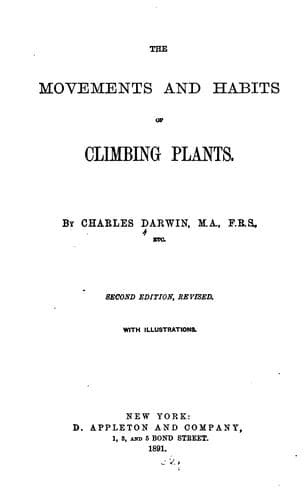
[Picture: Book cover]
THE MOVEMENTS
AND HABITS OF
CLIMBING PLANTS.
BY CHARLES DARWIN, F.R.S.
* * * * *
POPULAR EDITION
* * * * *
LONDON:
JOHN MURRAY, ALBEMARLE STREET.
1906.
PREFACE
THIS Essay first appeared in the ninth volume of the ‘Journal of the
Linnean Society,’ published in 1865. It is here reproduced in a
corrected and, I hope, clearer form, with some additional facts. The
illustrations were drawn by my son, George Darwin. Fritz Müller, after
the publication of my paper, sent to the Linnean Society (Journal, vol.
ix., p. 344) some interesting observations on the climbing plants of
South Brazil, to which I shall frequently refer. Recently two important
memoirs, chiefly on the difference in growth between the upper and lower
sides of tendrils, and on the mechanism of the movements of
twining-plants, by Dr. Hugo de Vries, have appeared in the ‘Arbeiten des
Botanischen Instituts in Würzburg,’ Heft. iii., 1873. These memoirs
ought to be carefully studied by every one interested in the subject, as
I can here give only references to the more important points. This
excellent observer, as well as Professor Sachs, {iv} attributes all the
movements of tendrils to rapid growth along one side; but, from reasons
assigned towards the close of my fourth chapter, I cannot persuade myself
that this holds good with respect to those due to a touch. In order that
the reader may know what points have interested me most, I may call his
attention to certain tendril-bearing plants; for instance, Bignonia
capreolata, Cobæa, Echinocystis, and Hanburya, which display as beautiful
adaptations as can be found in any part of the kingdom of nature. It is,
also, an interesting fact that intermediate states between organs fitted
for widely different functions, may be observed on the same individual
plant of Corydalis claviculata and the common vine; and these cases
illustrate in a striking manner the principle of the gradual evolution of
species.
APPENDIX TO PREFACE (1882).
SINCE the publication of this Edition two papers by eminent botanists
have appeared; Schwendener, ‘Das Winden der Pflanzen’ (Monatsberichte der
Berliner Akademie, Dec. 1881), and J. Sachs, ‘Notiz über Schlingpflanzen’
(Arbeiten des botanischen Instituts in Würzburg, Bd. ii. p. 719, 1882).
The view “that the capacity of revolving, on which most climbers depend,
is inherent, though undeveloped, in almost every plant in the vegetable
kingdom” (‘Climbing Plants,’ p. 205), has been confirmed by the
observations on circumnutation since given in ‘The Power of Movement in
Plants.’
ERRATA.
Public-domain text, read in full here on John Shaqi.
Reviews
Reviews
No reviews yet
Be the first to share your thoughts on this work.
Join the Discussion
Join the discussion
Sign in to leave a comment or review.
Sign InorCreate an account