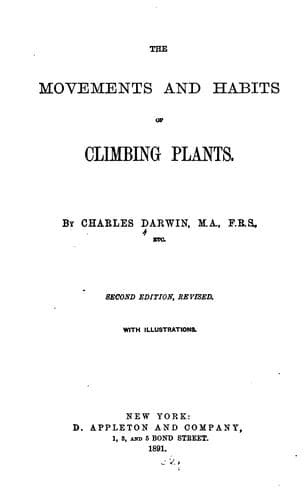
The Movements and Habits of Climbing PlantsDarwin, Charles
Science
The Movements and Habits of Climbing Plants
Darwin, Charles
Climbing plants; Geotropism; Plants; Plants -- Irritability and movements
Sachs attributes all the movements of tendrils to rapid growth on the
side opposite to that which becomes concave. These movements consist of
revolving nutation, the bending to and from the light, and in opposition
to gravity, those caused by a touch, and spiral contraction. It is rash
to differ from so great an authority, but I cannot believe that one at
least of these movements—curvature from a touch—is thus caused. {180} In
the first place it may be remarked that the movement of nutation differs
from that due to a touch, in so far that in some cases the two powers are
acquired by the same tendril at different periods of growth; and the
sensitive part of the tendril does not seem capable of nutation. One of
my chief reasons for doubting whether the curvature from a touch is the
result of growth, is the extraordinary rapidity of the movement. I have
seen the extremity of a tendril of _Passiflora gracilis_, after being
touched, distinctly bent in 25 seconds, and often in 30 seconds; and so
it is with the thicker tendril of Sicyos. It appears hardly credible
that their outer surfaces could have actually grown in length, which
implies a permanent modification of structure, in so short a time. The
growth, moreover, on this view must be considerable, for if the touch has
been at all rough the extremity is coiled in two or three minutes into a
spire of several turns.
When the extreme tip of the tendril of Echinocystis caught hold of a
smooth stick, it coiled itself in a few hours (as described at p. 132)
twice or thrice round the stick, apparently by an undulatory movement.
At first I attributed this movement to the growth of the outside; black
marks were therefore made, and the interspaces measured, but I could not
thus detect any increase in length. Hence it seems probable in this case
and in others, that the curvature of the tendril from a touch depends on
the contraction of the cells along the concave side. Sachs himself
admits {181} that “if the growth which takes place in the entire tendril
at the time of contact with a support is small, a considerable
acceleration occurs on the convex surface, but in general there is no
elongation on the concave surface, or there may even be a _contraction_;
in the case of a tendril of Cucurbita this contraction amounted to nearly
one-third of the original length.” In a subsequent passage Sachs seems
to feel some difficulty in accounting for this kind of contraction. It
must not however be supposed from the foregoing remarks that I entertain
any doubt, after reading De Vries’ observations, about the outer and
stretched surfaces of attached tendrils afterwards increasing in length
by growth. Such increase seems to me quite compatible with the first
movement being independent of growth. Why a delicate touch should cause
one side of a tendril to contract we know as little as why, on the view
held by Sachs, it should lead to extraordinarily rapid growth of the
opposite side.
Public-domain text, read in full here on John Shaqi.
Reviews
Reviews
No reviews yet
Be the first to share your thoughts on this work.
Elsewhere in the archive
Join the Discussion
Join the discussion
Sign in to leave a comment or review.
Sign InorCreate an account