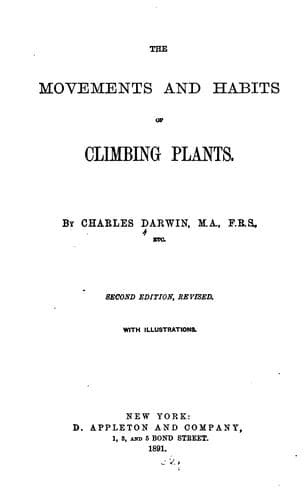
The Movements and Habits of Climbing PlantsDarwin, Charles
Science
The Movements and Habits of Climbing Plants
Darwin, Charles
Climbing plants; Geotropism; Plants; Plants -- Irritability and movements
Finally, climbing plants are sufficiently numerous to form a conspicuous
feature in the vegetable kingdom, more especially in tropical forests.
America, which so abounds with arboreal animals, as Mr. Bates remarks,
likewise abounds according to Mohl and Palm with climbing plants; and of
the tendril-bearing plants examined by me, the highest developed kinds
are natives of this grand continent, namely, the several species of
_Bignonia_, _Eccremocarpus_, _Cobæa_, and _Ampelopsis_. But even in the
thickets of our temperate regions the number of climbing species and
individuals is considerable, as will be found by counting them. They
belong to many and widely different orders. To gain some rude idea of
their distribution in the vegetable series, I marked, from the lists
given by Mohl and Palm (adding a few myself, and a competent botanist, no
doubt, could have added many more), all those families in Lindley’s
‘Vegetable Kingdom’ which include twiners, leaf-climbers, or
tendril-bearers. Lindley divides Phanerogamic plants into fifty-nine
Alliances; of these, no less than thirty-five include climbing plants of
the above kinds, hook and root-climbers being excluded. To these a few
Cryptogamic plants must be added. When we reflect on the wide separation
of these plants in the series, and when we know that in some of the
largest, well-defined orders, such as the Compositæ, Rubiaceæ,
Scrophulariaceæ, Liliaceæ, &c., species in only two or three genera have
the power of climbing, the conclusion is forced on our minds that the
capacity of revolving, on which most climbers depend, is inherent, though
undeveloped, in almost every plant in the vegetable kingdom.
It has often been vaguely asserted that plants are distinguished from
animals by not having the power of movement. It should rather be said
that plants acquire and display this power only when it is of some
advantage to them; this being of comparatively rare occurrence, as they
are affixed to the ground, and food is brought to them by the air and
rain. We see how high in the scale of organization a plant may rise,
when we look at one of the more perfect tendril-bearers. It first places
its tendrils ready for action, as a polypus places its tentacula. If the
tendril be displaced, it is acted on by the force of gravity and rights
it self. It is acted on by the light, and bends towards or from it, or
disregards it, whichever may be most advantageous. During several days
the tendrils or internodes, or both, spontaneously revolve with a steady
motion. The tendril strikes some object, and quickly curls round and
firmly grasps it. In the course of some hours it contracts into a spire,
dragging up the stem, and forming an excellent spring. All movements now
cease. By growth the tissues soon become wonderfully strong and durable.
The tendril has done its work, and has done it in an admirable manner.
FOOTNOTES.
Public-domain text, read in full here on John Shaqi.
Reviews
Reviews
No reviews yet
Be the first to share your thoughts on this work.
Elsewhere in the archive
Join the Discussion
Join the discussion
Sign in to leave a comment or review.
Sign InorCreate an account