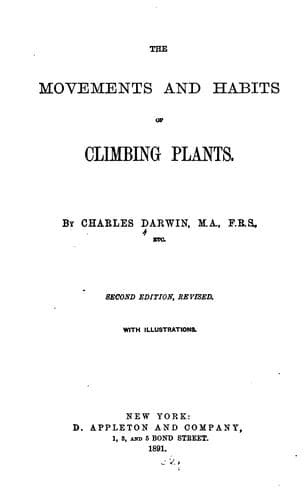
The Movements and Habits of Climbing PlantsDarwin, Charles
Science
The Movements and Habits of Climbing Plants
Darwin, Charles
Climbing plants; Geotropism; Plants; Plants -- Irritability and movements
The leaves, whilst young, are continually and spontaneously moving
slowly. A bell-glass was placed over a shoot secured to a stick, and the
movements of the leaves were traced on it during several days. A very
irregular line was generally formed; but one day, in the course of eight
hours and three quarters, the figure clearly represented three and a half
irregular ellipses, the most perfect one of which was completed in 2 hrs.
35 m. The two opposite leaves moved independently of each other. This
movement of the leaves would aid that of the internodes in bringing the
petioles into contact with surrounding objects. I discovered this
movement too late to be enabled to observe it in the other species; but
from analogy I can hardly doubt that the leaves of at least _C.
viticella_, _C. flammula_, and _C. vitalba_ move spontaneously; and,
judging from _C. Sieboldi_, this probably is the case with _C. montana_
and _C. calycina_. I ascertained that the simple leaves of _C.
glandulosa_ exhibited no spontaneous revolving movement.
_Clematis viticella_, var. _venosa_.—In this and the two following
species the power of spirally twining is completely lost, and this seems
due to the lessened flexibility of the internodes and to the interference
caused by the large size of the leaves. But the revolving movement,
though restricted, is not lost. In our present species a young
internode, placed in front of a window, made three narrow ellipses,
transversely to the direction of the light, at an average rate of 2 hrs.
40 m. When placed so that the movements were to and from the light, the
rate was greatly accelerated in one half of the course, and retarded in
the other, as with twining plants. The ellipses were small; the longer
diameter, described by the apex of a shoot bearing a pair of not expanded
leaves, was only 4⅝ inches, and that by the apex of the penultimate
internode only 1⅛ inch. At the most favourable period of growth each
leaf would hardly be carried to and fro by the movement of the internodes
more than two or three inches, but, as above stated, it is probable that
the leaves themselves move spontaneously. The movement of the whole
shoot by the wind and by its rapid growth, would probably be almost
equally efficient as these spontaneous movements, in bringing the
petioles into contact with surrounding objects.
Public-domain text, read in full here on John Shaqi.
Reviews
Reviews
No reviews yet
Be the first to share your thoughts on this work.
Join the Discussion
Join the discussion
Sign in to leave a comment or review.
Sign InorCreate an account