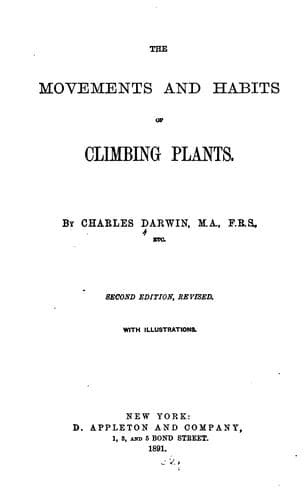
The Movements and Habits of Climbing PlantsDarwin, Charles
Science
The Movements and Habits of Climbing Plants
Darwin, Charles
Climbing plants; Geotropism; Plants; Plants -- Irritability and movements
The leaves bear four leaflets, themselves subdivided, and terminate in
much-branched tendrils. The main petiole of the leaf, whilst young,
moves spontaneously, and follows nearly the same irregular course and at
about the same rate as the internodes. The movement to and from the stem
is the most conspicuous, and I have seen the chord of a curved petiole
which formed an angle of 59° with the stem, in an hour afterwards making
an angle of 106°. The two opposite petioles do not move together, and
one is sometimes so much raised as to stand close to the stem, whilst the
other is not far from horizontal. The basal part of the petiole moves
less than the distal part. The tendrils, besides being carried by the
moving petioles and internodes, themselves move spontaneously; and the
opposite tendrils occasionally move in opposite directions. By these
combined movements of the young internodes, petioles, and tendrils, a
considerable space is swept in search of a support.
In young plants the tendrils are about three inches in length: they bear
two lateral and two terminal branches; and each branch bifurcates twice,
with the tips terminating in blunt double hooks, having both points
directed to the same side. All the branches are sensitive on all sides;
and after being lightly rubbed, or after coming into contact with a
stick, bend in about 10 m. One which had become curved in 10 m. after a
light rub, continued bending for between 3 hrs. and 4 hrs., and became
straight again in 8 hrs. or 9 hrs. Tendrils, which have caught nothing,
ultimately contract into an irregular spire, as they likewise do, only
much more quickly, after clasping a support. In both cases the main
petiole bearing the leaflets, which is at first straight and inclined a
little upwards, moves downwards, with the middle part bent abruptly into
a right angle; but this is seen in _E. miniatus_ more plainly than in _E.
scaber_. The tendrils in this genus act in some respects like those of
_Bignonia capreolata_; but the whole does not move from the light, nor do
the hooked tips become enlarged into cellular discs. After the tendrils
have come into contact with a moderately thick cylindrical stick or with
rugged bark, the several branches may be seen slowly to lift themselves
up, change their positions, and again come into contact with the
supporting surface. The object of these movements is to bring the
double-hooks at the extremities of the branches, which naturally face in
all directions, into contact with the wood. I have watched a tendril,
half of which had bent itself at right angles round the sharp corner of a
square post, neatly bring every single hook into contact with both
rectangular surfaces. The appearance suggested the belief, that though
the whole tendril is not sensitive to light, yet that the tips are so,
and that they turn and twist themselves towards any dark surface.
Ultimately the branches arrange themselves very neatly to all the
Public-domain text, read in full here on John Shaqi.
Reviews
Reviews
No reviews yet
Be the first to share your thoughts on this work.
Elsewhere in the archive
Join the Discussion
Join the discussion
Sign in to leave a comment or review.
Sign InorCreate an account