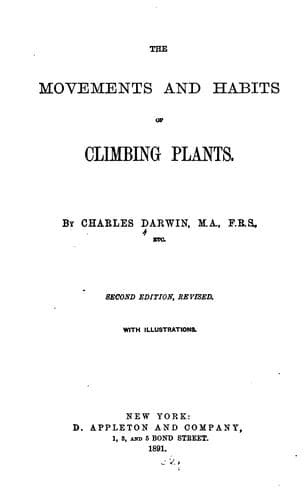
The Movements and Habits of Climbing PlantsDarwin, Charles
Science
The Movements and Habits of Climbing Plants
Darwin, Charles
Climbing plants; Geotropism; Plants; Plants -- Irritability and movements
irregularities of the most rugged bark, so that they resemble in their
irregular course a river with its branches, as engraved on a map. But
when a tendril has wound round a rather thick stick, the subsequent
spiral contraction generally draws it away and spoils the neat
arrangement. So it is, but not in quite so marked a manner, when a
tendril has spread itself over a large, nearly flat surface of rugged
bark. We may therefore conclude that these tendrils are not perfectly
adapted to seize moderately thick sticks or rugged bark. If a thin stick
or twig is placed near a tendril, the terminal branches wind quite round
it, and then seize their own lower branches or the main stem. The stick
is thus firmly, but not neatly, grasped. What the tendrils are really
adapted for, appears to be such objects as the thin culms of certain
grasses, or the long flexible bristles of a brush, or thin rigid leaves
such as those of the Asparagus, all of which they seize in an admirable
manner. This is due to the extremities of the branches close to the
little hooks being extremely sensitive to a touch from the thinnest
object, which they consequently curl round and clasp. When a small
brush, for instance, was placed near a tendril, the tips of each
sub-branch seized one, two, or three of the bristles; and then the spiral
contraction of the several branches brought all these little parcels
close together, so that thirty or forty bristles were drawn into a single
bundle, which afforded an excellent support.
Public-domain text, read in full here on John Shaqi.
Reviews
Reviews
No reviews yet
Be the first to share your thoughts on this work.
Elsewhere in the archive
Join the Discussion
Join the discussion
Sign in to leave a comment or review.
Sign InorCreate an account