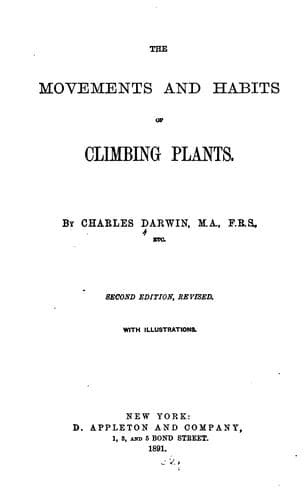
The Movements and Habits of Climbing PlantsDarwin, Charles
Science
The Movements and Habits of Climbing Plants
Darwin, Charles
Climbing plants; Geotropism; Plants; Plants -- Irritability and movements
CUCURBITACEÆ.—Homologous nature of the tendrils—_Echinocystis lobata_,
remarkable movements of the tendrils to avoid seizing the terminal
shoot—Tendrils not excited by contact with another tendril or by drops of
water—Undulatory movement of the extremity of the tendril—_Hanburya_,
adherent discs—VITACÆ—Gradation between the flower-peduncles and tendrils
of the vine—Tendrils of the Virginian Creeper turn from the light, and,
after contact, develop adhesive
discs—SAPINDACEÆ—PASSIFLORACEÆ—_Passiflora gracilis_—Rapid revolving
movement and sensitiveness of the tendrils—Not sensitive to the contact
of other tendrils or of drops of water—Spiral contraction of
tendrils—Summary on the nature and action of tendrils.
CUCURBITACEÆ.—The tendrils in this family have been ranked by competent
judges as modified leaves, stipules, or branches; or as partly a leaf and
partly a branch. De Candolle believes that the tendrils differ in their
homological nature in two of the tribes. {127a} From facts recently
adduced, Mr. Berkeley thinks that Payer’s view is the most probable,
namely, that the tendril is “a separate portion of the leaf itself;” but
much may be said in favour of the belief that it is a modified
flower-peduncle. {127b}
_Echinocystis lobata_.—Numerous observations were made on this plant
(raised from seed sent me by Prof. Asa Gray), for the spontaneous
revolving movements of the internodes and tendrils were first observed by
me in this case, and greatly perplexed me. My observations may now be
much condensed. I observed thirty-five revolutions of the internodes and
tendrils; the slowest rate was 2 hrs. and the average rate, with no great
fluctuations, 1 hr. 40 m. Sometimes I tied the internodes, so that the
tendrils alone moved; at other times I cut off the tendrils whilst very
young, so that the internodes revolved by themselves; but the rate was
not thus affected. The course generally pursued was with the sun, but
often in an opposite direction. Sometimes the movement during a short
time would either stop or be reversed; and this apparently was due to
interference from the light, as, for instance, when I placed a plant
close to a window. In one instance, an old tendril, which had nearly
ceased revolving, moved in one direction, whilst a young tendril above
moved in an opposite course. The two uppermost internodes alone revolve;
and as soon as the lower one grows old, only its upper part continues to
move. The ellipses or circles swept by the summits of the internodes are
about three inches in diameter; whilst those swept by the tips of the
tendrils, are from 15 to 16 inches in diameter. During the revolving
movement, the internodes become successively curved to all points of the
compass; in one part of their course they are often inclined, together
with the tendrils, at about 45° to the horizon, and in another part stand
vertically up. There was something in the appearance of the revolving
Public-domain text, read in full here on John Shaqi.
Reviews
Reviews
No reviews yet
Be the first to share your thoughts on this work.
Elsewhere in the archive
Join the Discussion
Join the discussion
Sign in to leave a comment or review.
Sign InorCreate an account