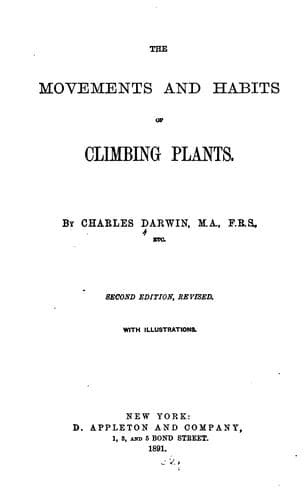
The Movements and Habits of Climbing PlantsDarwin, Charles
Science
The Movements and Habits of Climbing Plants
Darwin, Charles
Climbing plants; Geotropism; Plants; Plants -- Irritability and movements
internodes which continually gave the false impression that their
movement was due to the weight of the long and spontaneously revolving
tendril; but, on cutting off the latter with sharp scissors, the top of
the shoot rose only a little, and went on revolving. This false
appearance is apparently due to the internodes and tendrils all curving
and moving harmoniously together.
A revolving tendril, though inclined during the greater part of its
course at an angle of about 45° (in one case of only 37°) above the
horizon, stiffened and straightened itself from tip to base in a certain
part of its course, thus becoming nearly or quite vertical. I witnessed
this repeatedly; and it occurred both when the supporting internodes were
free and when they were tied up; but was perhaps most conspicuous in the
latter case, or when the whole shoot happened to be much inclined. The
tendril forms a very acute angle with the projecting extremity of the
stem or shoot; and the stiffening always occurred as the tendril
approached, and had to pass over the shoot in its circular course. If it
had not possessed and exercised this curious power, it would infallibly
have struck against the extremity of the shoot and been arrested. As
soon as the tendril with its three branches begins to stiffen itself in
this manner and to rise from an inclined into a vertical position, the
revolving motion becomes more rapid; and as soon as the tendril has
succeeded in passing over the extremity of the shoot or point of
difficulty, its motion, coinciding with that from its weight, often
causes it to fall into its previously inclined position so quickly, that
the apex could be seen travelling like the minute hand of a gigantic
clock.
Public-domain text, read in full here on John Shaqi.
Reviews
Reviews
No reviews yet
Be the first to share your thoughts on this work.
Elsewhere in the archive
Join the Discussion
Join the discussion
Sign in to leave a comment or review.
Sign InorCreate an account