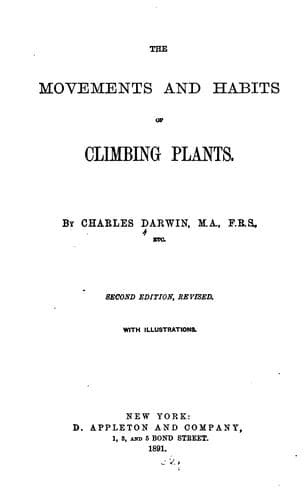
The Movements and Habits of Climbing PlantsDarwin, Charles
Science
The Movements and Habits of Climbing Plants
Darwin, Charles
Climbing plants; Geotropism; Plants; Plants -- Irritability and movements
The revolving movement of a tendril is not stopped by the curving of its
extremity after it has been touched. When one of the lateral branches
has firmly clasped an object, the middle branch continues to revolve.
When a stem is bent down and secured, so that the tendril depends but is
left free to move, its previous revolving movement is nearly or quite
stopped; but it soon begins to bend upwards, and as soon as it has become
horizontal the revolving movement recommences. I tried this four times;
the tendril generally rose to a horizontal position in an hour or an hour
and a half; but in one case, in which a tendril depended at an angle of
45° beneath the horizon, the uprising took two hours; in half an hour
afterwards it rose to 23° above the horizon and then recommenced
revolving. This upward movement is independent of the action of light,
for it occurred twice in the dark, and on another occasion the light came
in on one side alone. The movement no doubt is guided by opposition to
the force of gravity, as in the case of the ascent of the plumules of
germinating seeds.
A tendril does not long retain its revolving power; and as soon as this
is lost, it bends downwards and contracts spirally. After the revolving
movement has ceased, the tip still retains for a short time its
sensitiveness to contact, but this can be of little or no use to the
plant.
Though the tendril is highly flexible, and though the extremity travels,
under favourable circumstances, at about the rate of an inch in two
minutes and a quarter, yet its sensitiveness to contact is so great that
it hardly ever fails to seize a thin stick placed in its path. The
following case surprised me much: I placed a thin, smooth, cylindrical
stick (and I repeated the experiment seven times) so far from a tendril,
that its extremity could only curl half or three-quarters round the
stick; but I always found that the tip managed in the course of a few
hours to curl twice or even thrice round the stick. I at first thought
that this was due to rapid growth on the outside; but by coloured points
and measurements I proved that there had been no sensible increase of
length within the time. When a stick, flat on one side, was similarly
placed, the tip of the tendril could not curl beyond the flat surface,
but coiled itself into a helix, which, turning to one side, lay flat on
the little flat surface of wood. In one instance a portion of tendril
three-quarters of an inch in length was thus dragged on to the flat
surface by the coiling in of the helix. But the tendril thus acquires a
very insecure hold, and generally after a time slips off. In one case
alone the helix subsequently uncoiled itself, and the tip then passed
round and clasped the stick. The formation of the helix on the flat side
of the stick apparently shows us that the continued striving of the tip
to curl itself closely inwards gives the force which drags the tendril
round a smooth cylindrical stick.
Public-domain text, read in full here on John Shaqi.
Reviews
Reviews
No reviews yet
Be the first to share your thoughts on this work.
Elsewhere in the archive
Join the Discussion
Join the discussion
Sign in to leave a comment or review.
Sign InorCreate an account