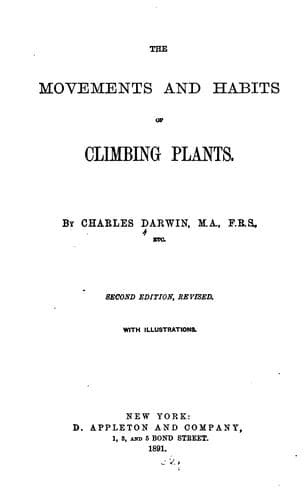
The Movements and Habits of Climbing PlantsDarwin, Charles
Science
The Movements and Habits of Climbing Plants
Darwin, Charles
Climbing plants; Geotropism; Plants; Plants -- Irritability and movements
long and thin main peduncle, though spontaneously moving, is not
sensitive and never clasps a support. Nor does it ever contract
spirally, {152} although a contraction of this kind apparently would have
been of service to the plant in climbing. Nevertheless it climbs pretty
well without this aid. The seed-capsules though light, are of enormous
size (hence its English name of balloon-vine), and as two or three are
carried on the same peduncle, the tendrils rising close to them may be of
service in preventing their being dashed to pieces by the wind. In the
hothouse the tendrils served simply for climbing.
The position of the tendrils alone suffices to show their homological
nature. In two instances one of two tendrils produced a flower at its
tip; this, however, did not prevent its acting properly and curling round
a twig. In a third case both lateral branches which ought to have been
modified into tendrils, produced flowers like the central branch, and had
quite lost their tendril-structure.
I have seen, but was not enabled carefully to observe, only one other
climbing Sapindaceous plant, namely, _Paullinia_. It was not in flower,
yet bore long forked tendrils. So that, _Paullinia_, with respect to its
tendrils, appears to bear the same relation to _Cardiospermum_ that
_Cissus_ does to _Vitis_.
PASSIFLORACEÆ.—After reading the discussion and facts given by Mohl (p.
47) on the nature of the tendrils in this family, no one can doubt that
they are modified flower-peduncles. The tendrils and the
flower-peduncles rise close side by side; and my son, William E. Darwin,
made sketches for me of their earliest state of development in the hybrid
_P. floribunda_. The two organs appear at first as a single papilla
which gradually divides; so that the tendril appears to be a modified
branch of the flower-peduncle. My son found one very young tendril
surmounted by traces of floral organs, exactly like those on the summit
of the true flower-peduncle at the same early age.
Public-domain text, read in full here on John Shaqi.
Reviews
Reviews
No reviews yet
Be the first to share your thoughts on this work.
Elsewhere in the archive
Join the Discussion
Join the discussion
Sign in to leave a comment or review.
Sign InorCreate an account