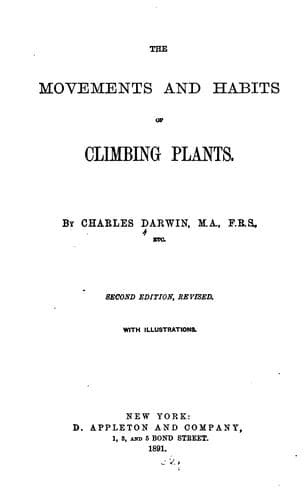
The Movements and Habits of Climbing PlantsDarwin, Charles
Science
The Movements and Habits of Climbing Plants
Darwin, Charles
Climbing plants; Geotropism; Plants; Plants -- Irritability and movements
_Passiflora gracilis_.—This well-named, elegant, annual species differs
from the other members of the group observed by me, in the young
internodes having the power of revolving. It exceeds all the other
climbing plants which I have examined, in the rapidity of its movements,
and all tendril-bearers in the sensitiveness of the tendrils. The
internode which carries the upper active tendril and which likewise
carries one or two younger immature internodes, made three revolutions,
following the sun, at an average rate of 1 hr. 4 m.; it then made, the
day becoming very hot, three other revolutions at an average rate of
between 57 and 58 m.; so that the average of all six revolutions was 1
hr. 1 m. The apex of the tendril describes elongated ellipses, sometimes
narrow and sometimes broad, with their longer axes inclined in slightly
different directions. The plant can ascend a thin upright stick by the
aid of its tendrils; but the stem is too stiff for it to twine spirally
round it, even when not interfered with by the tendrils, these having
been successively pinched off at an early age.
When the stem is secured, the tendrils are seen to revolve in nearly the
same manner and at the same rate as the internodes. {154} The tendrils
are very thin, delicate, and straight, with the exception of the tips,
which are a little curved; they are from 7 to 9 inches in length. A
half-grown tendril is not sensitive; but when nearly full-grown they are
extremely sensitive. A single delicate touch on the concave surface of
the tip soon caused one to curve; and in 2 minutes it formed an open
helix. A loop of soft thread weighing one thirty-second of a grain (2.02
mg.) placed most gently on the tip, thrice caused distinct curvature. A
bent bit of thin platina wire weighing only fiftieth of a grain (1.23
mg.) twice produced the same effect; but this latter weight, when left
suspended, did not suffice to cause a permanent curvature. These trials
were made under a bell-glass, so that the loops of thread and wire were
not agitated by the wind. The movement after a touch is very rapid: I
took hold of the lower part of several tendrils, and then touched their
concave tips with a thin twig and watched them carefully through a lens;
the tips evidently began to bend after the following intervals—31, 25,
32, 31, 28, 39, 31, and 30 seconds; so that the movement was generally
perceptible in half a minute after a touch; but on one occasion it was
distinctly visible in 25 seconds. One of the tendrils which thus became
bent in 31 seconds, had been touched two hours previously and had coiled
into a helix; so that in this interval it had straightened itself and had
perfectly recovered its irritability.
Public-domain text, read in full here on John Shaqi.
Reviews
Reviews
No reviews yet
Be the first to share your thoughts on this work.
Elsewhere in the archive
Join the Discussion
Join the discussion
Sign in to leave a comment or review.
Sign InorCreate an account