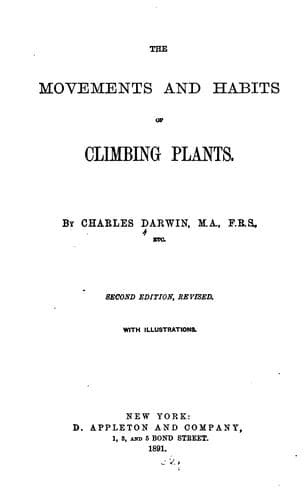
The Movements and Habits of Climbing PlantsDarwin, Charles
Science
The Movements and Habits of Climbing Plants
Darwin, Charles
Climbing plants; Geotropism; Plants; Plants -- Irritability and movements
_Passiflora punctata_.—The internodes do not move, but the tendrils
revolve regularly. A half-grown and very sensitive tendril made three
revolutions, opposed to the course of the sun, in 3 hrs. 5 m., 2 hrs. 40
m. and 2 hrs. 50 m.; perhaps it might have travelled more quickly when
nearly full-grown. A plant was placed in front of a window, and, as with
twining stems, the light accelerated the movement of the tendril in one
direction and retarded it in the other; the semicircle towards the light
being performed in one instance in 15 m. less time and in a second
instance in 20 m. less time than that required by the semicircle towards
the dark end of the room. Considering the extreme tenuity of these
tendrils, the action of the light on them is remarkable. The tendrils
are long, and, as just stated, very thin, with the tip slightly curved or
hooked. The concave side is extremely sensitive to a touch—even a single
touch causing it to curl inwards; it subsequently straightened itself,
and was again ready to act. A loop of soft thread weighing one
fourteenth of a grain (4.625 mg.) caused the extreme tip to bend; another
time I tried to hang the same little loop on an inclined tendril, but
three times it slid off; yet this extraordinarily slight degree of
friction sufficed to make the tip curl. The tendril, though so
sensitive, does not move very quickly after a touch, no conspicuous
movement being observable until 5 or 10 m. had elapsed. The convex side
of the tip is not sensitive to a touch or to a suspended loop of thread.
On one occasion I observed a tendril revolving with the convex side of
the tip forwards, and in consequence it was not able to clasp a stick,
against which it scraped; whereas tendrils revolving with the concave
side forward, promptly seize any object in their path.
_Passiflora quadrangularis_.—This is a very distinct species. The
tendrils are thick, long, and stiff; they are sensitive to a touch only
on the concave surface towards the extremity. When a stick was placed so
that the middle of the tendril came into contact with it, no curvature
ensued. In the hothouse a tendril made two revolutions, each in 2 hrs.
22 m.; in a cool room one was completed in 3 hrs., and a second in 4 hrs.
The internodes do not revolve; nor do those of the hybrid _P.
floribunda_.
_Tacsonia manicata_.—Here again the internodes do not revolve. The
tendrils are moderately thin and long; one made a narrow ellipse in 5
hrs. 20 m., and the next day a broad ellipse in 5 hrs. 7 m. The
extremity being lightly rubbed on the concave surface, became just
perceptibly curved in 7 m., distinctly in 10 m., and hooked in 20 m.
Public-domain text, read in full here on John Shaqi.
Reviews
Reviews
No reviews yet
Be the first to share your thoughts on this work.
Elsewhere in the archive
Join the Discussion
Join the discussion
Sign in to leave a comment or review.
Sign InorCreate an account