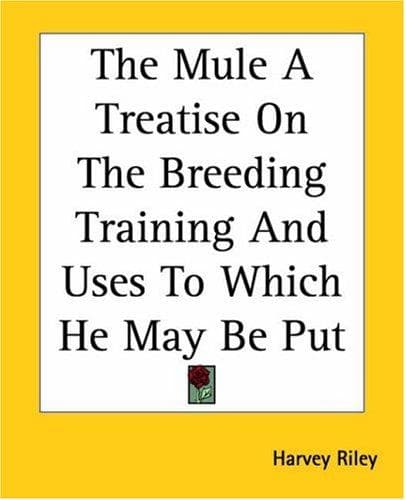
The Mule: A Treatise on the Breeding, Training, and Uses to Which He May Be Put — John Shaqi
The Mule: A Treatise on the Breeding, Training, and Uses to Which He May Be PutRiley, Harvey
History
The Mule: A Treatise on the Breeding, Training, and Uses to Which He May Be Put
Riley, Harvey
Mules
In looking over a book, with the title of "Domestic Animals," I notice
that the author, Mr. R.L. Allen, has copied from the official report of
the Agricultural Committee of South Carolina, and asserts that a mule is
fit for service sooner than a horse. This is not true; and to prove that
it is not, I will give what I consider to be ample proof. In the first
place, a mule at three years old is just as much and even more of a colt
than a horse is. And he is as much out of condition, on account of
cutting teeth, distemper, and other colt ailments, as it is possible to
be. Get a three year old mule tired and fatigued, and in nine cases out
of ten he will get so discouraged that it will be next to impossible to
get him home or into camp. A horse colt, if able to travel at all, will
work his way home cheerfully; but the young mule will sulk, and in many
instances will not move an inch while life lasts. An honest horse will
try to help himself, and do all he can for you, especially if you treat
him kindly. The mule colt will, just as likely as not, do all he can to
make it inconvenient for you and him.
To show of how little service three year old mules are to the
Government, I will give the number handled by me during part of 1864 and
1865.
On the 1st of September, 1864, I had charge of five thousand and
eighty-two mules; and during the same month I received two thousand two
hundred and ten, and issued to the Armies of the Potomac, the James, and
the Shenandoah, three thousand five hundred and seventy-one, which left
us on hand, on the 1st of October, three thousand seven hundred and
twenty-one. During the month of October we received only nine hundred
and eighty, and issued two thousand five hundred and thirty, which left
us on hand, on the 1st of November, two thousand one hundred and
seventy-one. During November we received two thousand one hundred and
eighty-six, and issued to the army one thousand seven hundred and
fifty-seven, which left us on hand, on the 1st of December, two thousand
four hundred and thirty mules. Now mark the deaths.
During the month of September, 1864, there died in the corral fifteen
mules. In October, six died. In November, three; and in December, eight.
They were all two and three years old.
Public-domain text, read in full here on John Shaqi.
Reviews
Reviews
No reviews yet
Be the first to share your thoughts on this work.
Join the Discussion
Join the discussion
Sign in to leave a comment or review.
Sign InorCreate an account