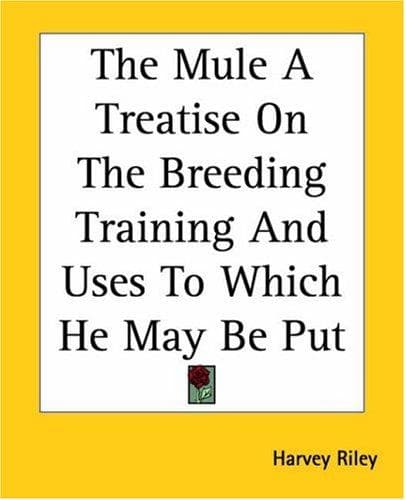
The Mule: A Treatise on the Breeding, Training, and Uses to Which He May Be Put — John Shaqi
The Mule: A Treatise on the Breeding, Training, and Uses to Which He May Be PutRiley, Harvey
History
The Mule: A Treatise on the Breeding, Training, and Uses to Which He May Be Put
Riley, Harvey
Mules
A great many persons insist that a mule has no marrow in the bones of
his legs. This is a very singular error. The bone of the mule's leg has
a cavity, and is as well filled with marrow as the horse's. It also
varies in just the same proportion as in the horse's leg. The feet of
some mules, however, will crack and split, but in most cases it is the
result of bad shoeing. It at times occurs from a lack of moisture to the
foot; and is seen among mules used in cities, where there are no
facilities for driving them into running water every day, to soften the
feet and keep them moist.
CONTENTS.
Best Method of Breaking
Value of Kind Treatment
How to Harness
Injured by Working too Young
What the Mule can Endure
Color and Peculiar Habits
Mexican Mules, and Packing
The Agricultural Committee
Working Condition of Mules
Spotted Mules
Mule-Breeding and Raising
How Colts should be Handled
Packing Mules
Physical Constitution
Value of Harnessing Properly
Government Wagons
More about Breeding Mules
Ancient History of the Mule
Table of Statistics
14 Portraits of Celebrated Mules
Diseases Common to the Mule, and how they should be treated
CHAPTER I.
HOW MULES SHOULD BE TREATED IN BREAKING.
I have long had it in contemplation to write something concerning the
mule, in the hope that it might be of benefit to those who had to deal
with him, as well in as out of the army, and make them better acquainted
with his habits and usefulness. The patient, plodding mule is indeed an
animal that has served us well in the army, and done a great amount of
good for humanity during the late war. He was in truth a necessity to
the army and the Government, and performed a most important part in
supplying our army in the field. That he will perform an equally
important part in the future movements of our army is equally clear, and
should not be lost sight of by the Government. It has seemed to me
somewhat strange, then, that so little should have been written
concerning him, and so little pains taken to improve his quality. I have
noticed in the army that those who had most to do with him were the
least acquainted with his habits, and took the least pains to study his
disposition, or to ascertain by proper means how he could be made the
most useful. The Government might have saved hundreds of thousands of
dollars, if, when the war began, there had been a proper understanding
of this animal among its employees.
Public-domain text, read in full here on John Shaqi.
Reviews
Reviews
No reviews yet
Be the first to share your thoughts on this work.
Join the Discussion
Join the discussion
Sign in to leave a comment or review.
Sign InorCreate an account