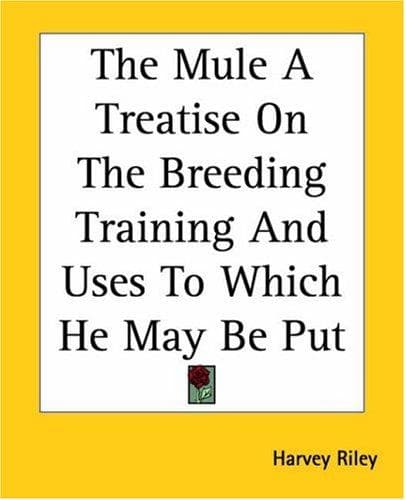
The Mule: A Treatise on the Breeding, Training, and Uses to Which He May Be PutRiley, Harvey
History
The Mule: A Treatise on the Breeding, Training, and Uses to Which He May Be Put
Riley, Harvey
Mules
There was one great difficulty the Agricultural Committee of South
Carolina had to contend with, and it was this. At the time it had the
subject of the mule under consideration, he was not used generally
throughout the United States. I can easily understand, therefore, that
the committee obtained its knowledge from the very few persons who had
them, and made the best report it could under the circumstances. Indeed,
I firmly believe the report was written with the intention of giving
correct information, but it failed entirely. In recommending any thing
of this kind, great care should be taken not to lead the inexperienced
astray, and to give only such facts as are obtained from thorough
knowledge; and no man should be accepted as authority in the care and
treatment of animals, unless he has had long experience with them, and
has made them a subject of study.
A few words more on breaking the mule. Don't fight or abuse him. After
you have harnessed him, and he proves to be refractory, keep your own
temper, slack your reins, push him round, backward and forward, not
roughly; and if he will not go, and do what you want, tie him to a post
and let him stand there a day or so without food or water. Take care,
also, that he does not lie down, and be careful to have a person to
guard him, so that he does not foul in the harness. If he will not go,
after a day or two of this sort of treatment, give him one or two more
of it, and my word for it, he will come to his senses and do any thing
you want from that time forward. Some persons assert that the mule is a
very cunning animal; others assert that he is dull and stupid, and
cannot be made to understand what you want. He is, I admit, what may be
called a tricky animal; but, for experiment sake, just play one or two
tricks with him, and he will show you by his action that he understands
them well. Indeed, he knows a great deal more than he generally gets
credit for, and few animals are more capable of appreciating proper
treatment. Like many other species of animal, there are scarcely two to
be found of precisely the same temper and disposition, if we except the
single vice of kicking, which they will all do, especially when well fed
and rested. And we can excuse even this vice in consideration of the
fact, that the mule is not a natural animal, but only an invention of
man. Some persons are inclined to think that, when a mule is a kicker,
he has not been properly broken. I doubt if you can break a mule so that
he will not kick a stranger at sight, especially if he be under six
years old. The only way to keep a mule from kicking you is to handle it
a great deal when young, and accustom it to the ways and actions of men.
You must through kindness convince it that you are not going to harm or
abuse it; and you can do that best by taking hold of it in a gentle
manner every time it appears to be frightened. Such treatment I have
always found more effective than all the beating and abusing you can
apply.
Public-domain text, read in full here on John Shaqi.
Reviews
Reviews
No reviews yet
Be the first to share your thoughts on this work.
Join the Discussion
Join the discussion
Sign in to leave a comment or review.
Sign InorCreate an account