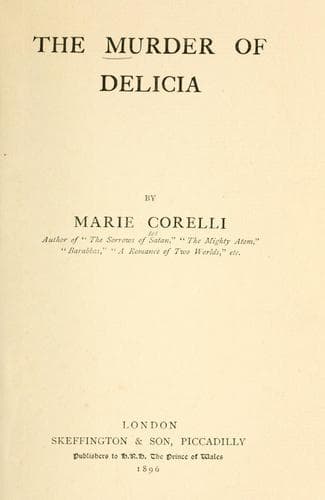
Detective and mystery stories; English fiction -- 19th century
‘Ungrateful! How strange that word sounds from your lips! Why use it
at all? You are surely the last person on earth who should speak of
gratitude, for you owe no one anything. You have worked for your
fame,—worked harder than anyone I know,—and you have won it; you have
given out the treasures of your genius to the public, and they reward
you by their love and honour; it is a natural sequence of cause and
effect. There is no reason why you should be grateful for what is
merely the just recognition of your worth.’
‘You think not?’ said Delicia, still smiling. ‘Ah, but I cannot quite
agree with you! You see there have been so many who have toiled for
fame and never won it,—so many who have poured out the “treasures of
their genius,” to quote your own words, on a totally unappreciative
world which has never recognised them till long after they are dead.
And that is why I consider one cannot be too grateful for a little
kindness from one’s fellow-creatures while one is living; though, if you
ask the Press people, they will tell you it’s a very bad sign of your
quality as an author if you succeed. The only proofs of true genius
are, never to sell one’s books at all, die burdened with debts and
difficulties, and leave your name and fame to be glorified by a
posterity whom you will never know!’
Valdis laughed; and Delicia, her eyes sparkling with fun, rose from her
chair and took up a newspaper from one of the side tables close by.
‘Listen!’ she said. ‘This appears in yesterday’s _Morning Chanticleer_,
_apropos_ of your humble servant—“The rampant lady-novelist, known as
Delicia Vaughan, is at it again. Not content with having married
‘Beauty’ Carlyon of the Guards, who has just stepped into his deceased
brother’s titled shoes and is now Lord Carlyon, she is about to issue a
scathing book on the manners and morals of the present age, written, no
doubt, in the usual hysterical style affected by female _poseurs_ in
literature, whose works appeal chiefly to residents up Brixton and
Clapham way. We regret that ‘Lady’ Carlyon does not see the necessity
of ‘assuming dignity,’ even if she hath it not, on her elevation,
through her husband, to the circles of the ‘upper ten.’” There, what do
you think of that?’ she asked gaily, as she flung the journal down.
Valdis had risen, and stood confronting her with frowning brow and
flashing eyes. ‘Think of it!’ he said angrily, ‘Why, that I should like
to horse-whip the dirty blackguard who wrote it!’
Delicia looked up at him in genuine amazement.
‘Dear me!’ she exclaimed playfully. ‘But why so fierce, friend Ernani?
This is nothing—nothing at all to what the papers generally say of me.
I don’t mind it in the least; it rather amuses me, on the whole.’
Public-domain text, read in full here on John Shaqi.
Reviews
Reviews
No reviews yet
Be the first to share your thoughts on this work.
Join the Discussion
Join the discussion
Sign in to leave a comment or review.
Sign InorCreate an account