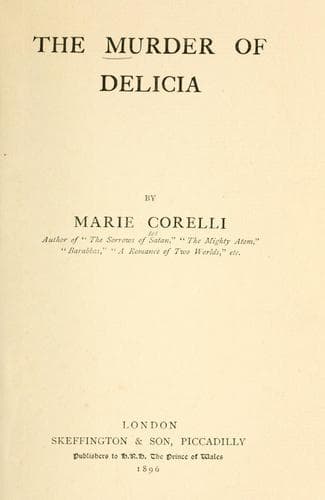
Detective and mystery stories; English fiction -- 19th century
She flung aside the letter and turned over the morning paper. There she
found, under the heading of ‘Scene at a London Club,’ an account of
Aubrey Grovelyn’s horse-whipping at the hands of Paul Valdis. The
_exposé_ of the so-called ‘poet,’ who, as Mr Brown, had been steadily
booming himself, was cautiously hinted at in darkly ambiguous terms—no
journal likes to admit that it has been cleverly fooled by one of its
own staff. And great editors, who are anywhere and everywhere except
where they should be, namely, in the editorial room, are naturally loth
to make public the results of their own inattention to business. They do
not like to confess that, in their love of pleasure and their devotion
to race-meetings and shooting-parties, it often happens that the very
porters guarding the doors of their offices know more about the staff
than they do. The porter can tell exactly the hour that Mr B—— comes in
to the office at night, the shortness of the time he stays there, and
the precipitate hurry with which he goes home to bed. The porter knows
that Mr B—— is paid five hundred a year for doing hard work at that
office during a certain number of hours, and that Mr B—— seldom looks in
for more than one hour, having other work on other papers, about which
he says nothing. And that, therefore, Mr B—— is distinctly ‘doing’ his
editor and proprietor. But as long as editors and proprietors prefer to
caper about at the heels of ‘swagger’ society instead of attending
strictly to their duties and to the grave responsibilities of
journalism, so long will the British Press be corrupted by underlings,
and ‘used’ for purposes which are neither honourable nor national, nor
in any way exact, as reflecting the real current of public opinion.
Delicia knew all this of old, hence her indifference to the press
generally. She had always been entertained and surprised at the naïve
delight with which certain society ‘belles’ had shown her descriptions
of themselves in certain fashionable journals, where their personal
attractions were enumerated and discussed as if they were nothing more
than cattle in a market. She could never understand what pleasure there
was in the vulgar compliments of the cheap paragraphist. And in the
same way she never thought it worth while to attach importance to the
scurrilities that appeared in similar quarters concerning all those
women who stood aloof from self-advertisement and declined to ‘give
themselves away’ by consenting to the maudlin puffery of the ‘ladies’
paper.’ So that the lofty tone of injury her husband assumed in his
letter not only struck her as mean, but infinitely grotesque as well.
She did not answer him, nor did he write again; and she passed a quiet
fortnight at Broadstairs, finishing some literary work she had promised
to her publishers at a certain date, and trying to think as little as
possible of herself or her private griefs. When she was not engaged in
Public-domain text, read in full here on John Shaqi.
Reviews
Reviews
No reviews yet
Be the first to share your thoughts on this work.
Elsewhere in the archive
Join the Discussion
Join the discussion
Sign in to leave a comment or review.
Sign InorCreate an account