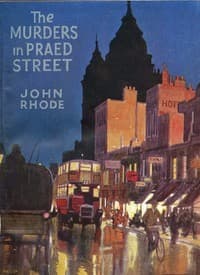
Meanwhile Mr. Pargent had stood for an instant upon the refuge in the
middle of Praed Street, a puzzled expression on his face. An
approaching taxi-driver noticed his swaying form and swerved sharply,
just in time to avoid him as he crashed forward into the road-way. The
taxi-driver’s action caused a sudden check to the traffic, and for an
instant there was a chaos of skidding vehicles, screeching brakes, and
blasphemous language. Then the nearest drivers jumped from their seats
and clustered round the prone form. A majestic policeman, setting a
calm and undeviating course through the tumult, knelt down and turned
the body over. Mr. Pargent was dead.
The newspaper which Mr. Ludgrove bought at Wokingham station and read
carefully during his journey to Waterloo contained nothing more than a
bare statement that the famous poet, Richard Pargent, had fallen dead
in Praed Street, and that, upon the body being conveyed to the
mortuary, a blade was found in it, with the point entering the heart.
Round these facts a formidable structure of conjecture and
reminiscence was built up. There was an obituary notice, in which Mr.
Pargent’s Christian names and the titles of his published works were
incorrectly stated. There was a résumé of the case of Mr. Tovey, and a
photograph of Praed Street, with heavy black crosses marking the
places where the murders had taken place. Finally there was a leading
article, in which the responsibility for the murders was ingeniously
fixed upon the Government, which in consequence came in for severe
criticism. In fact, the murder of Mr. Pargent was evidently the topic
of the day.
Mr. Ludgrove sat with his haversack beside him on the carriage seat,
even his beloved plants unheeded. He read every bit of the paper over
and over again, seeking for some clue which might account for the
crime. The description ended with the words “the police are, however,
in possession of a clue, the nature of which they are not at present
prepared to divulge, but which, they are confident, will lead to
startling developments in the near future.” Mr. Ludgrove smiled rather
cynically as he read them. They seemed to him to have a somewhat
familiar ring.
He had the paper in his hand as he walked into Mr. Copperdock’s shop
to get his key, and his friend caught sight of it. “So you’ve seen the
news, then?” he said excitedly.
Mr. Ludgrove nodded gravely. “I have been reading the account as I
came up in the train,” he replied.
Public-domain text, read in full here on John Shaqi.
Reviews
Reviews
No reviews yet
Be the first to share your thoughts on this work.
Join the Discussion
Join the discussion
Sign in to leave a comment or review.
Sign InorCreate an account