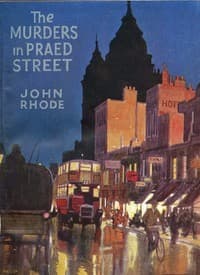
Ahead of him was the Express Train, a public-house which had
presumably been built and named at the time of the coming of the
railway. It was closing time by now, and a stream of gesticulating
figures was being disgorged upon the crowded pavement. Mr. Tovey
looked up as he heard the turmoil. The cold air and comparative
darkness, after the warmth and light of the bar, seemed to have had an
unsteadying effect upon the ejected guests. They lurched about the
pavement singing snatches of ribald songs, arguing heatedly in loud
voices.
Mr. Tovey frowned. Nice way to spend a Sunday evening! Thank God, he
didn’t live in Praed Street, anyhow. He wasn’t going to be barged off
the pavement by a lot of drunken hooligans, not he. Putting his head a
trifle further down, like a bull about to charge, he strode straight
ahead in an undeviating line. One man lurched into him, another
jostled him from behind, and a menacing voice, its effect somewhat
marred by a loud hiccough, called out, “’ere, ’oo the ’ell d’yer think
you’re pushin’?”
And then Mr. Tovey, with a queer strangled cry, suddenly collapsed in
a heap upon the muddy pavement.
Chapter II
The Herbalist
It is the proud boast of our modern educationalists that the process
of forcing knowledge down unwilling throats, known as compulsory
education, has resulted in the triumph of science over superstition.
Alchemy and astrology, the magic of the Middle Ages, have given place
to chemistry and astronomy, the mysteries of which are displayed
before the wondering eyes of the elementary scholar. The Age of
Superstition is commonly supposed to have fled before the progress of
the Age of Materialism.
This supposition is demonstrably false. At no other age in the earth’s
history has superstition owned so many votaries. From the most rapt
spiritualist to the man who refuses to walk under a ladder, the world
is full of people who allow superstition to play an important part in
their lives. In the neighbourhood of Praed Street fortune tellers and
interpreters of dreams are superstition’s most popular ministers,
though it may come as a surprise to many that a brass plate nailed to
the door of a house in the Harrow Road advertises the existence of the
British College of Astrology.
Even Alchemy is not without its devotees, although the alchemist has
forsaken the more picturesque apparatus of his stock-in-trade. He now
owns a small shop, the darker the better, and fills the windows with a
curious assortment of dried herbs, each with a notice affixed to it
describing its virtues. You may go in and buy two pennyworth of some
dried plant with a high-sounding Latin name, the herbalist assuring
you that, mixed with boiling water and drunk as tea, it will cure the
most obscure disease. If you have sufficient faith, it probably will.
Public-domain text, read in full here on John Shaqi.
Reviews
Reviews
No reviews yet
Be the first to share your thoughts on this work.
Join the Discussion
Join the discussion
Sign in to leave a comment or review.
Sign InorCreate an account