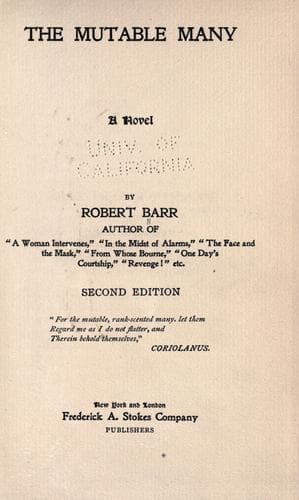
Factories -- Fiction; London (England) -- Fiction; Love stories; Strikes and lockouts -- Fiction
Once the fight was on, Sartwell determined to give no quarter. He
resolved to fill up the works, if possible, with men from outside,
and to take back none of the old employees who did not sign a paper
promising to abandon the Union. In the former strike he had been anxious
to get his men back in a body, and had made no real attempt to fill
their places. He knew in the beginning of the second struggle that
he was fighting for his life, and that if he suffered defeat he would
resign, and the place that had known him for years would know him no
more. He had no fear that the company would discharge him if he lost the
battle,--in fact he knew they would use every effort to induce him to
remain; but it was his own stubborn pride, as his wife called it, that
he felt he could not overcome even if he had wished to do so. Sartwell,
like certain swords of finely-tempered steel, would break, but would not
bend. Years of unflinching determination in what he thought was right
had made him a man over whom he himself had but slight control; and he
sometimes recognized with grim humour that while he could persuade
all his _confrères_ to take a devious but safe course upon any given
problem, he could not induce himself to follow anything but the straight
line. He worked night and day at the task of filling the factory with
new men. He scoured the country for them, and his telegraph bills alone
were enormous; but men were scarce--good men are always scarce, and now
even indifferent workers were hard to find. Gibbons had once said that
the workingman of modern times suffers from the fact that he is merely a
cog in a big wheel, but this truism tells also against the employer who
is trying to fill his shops. If a cog is useless by itself it must not
be forgotten that the wheel is also useless until the cog is replaced.
It is easy for an employer to supply the place of a single cog; but
when the whole wheel is cogless, ninety-nine cogs are of no avail if the
hundredth necessary to complete the circle cannot be found.
Public-domain text, read in full here on John Shaqi.
Reviews
Reviews
No reviews yet
Be the first to share your thoughts on this work.
Elsewhere in the archive
Join the Discussion
Join the discussion
Sign in to leave a comment or review.
Sign InorCreate an account