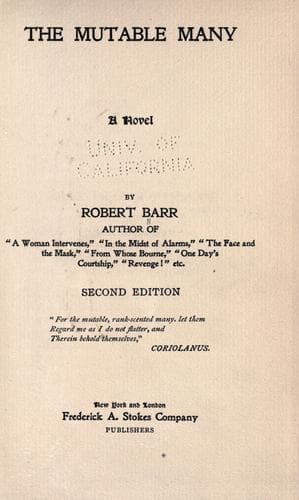
Factories -- Fiction; London (England) -- Fiction; Love stories; Strikes and lockouts -- Fiction
It was here that Sartwell had the first touch of his opponent’s quality,
and his anger was lost in admiration for the young man’s shrewdness and
knowledge of the business. The fight had been conducted so quietly
that no one in the neighbourhood would have known, from any sign of
disturbance, that war was in progress. Marsten made no attempt to buy
off the new men, who came and went from the works unmolested by the
pickets. Marsten sometimes talked with the strangers, telling them of
the strike, and asking where they came from; advising them to get work
elsewhere, but never making any attempt either to coerce or to bribe
them. Sartwell wondered at this, and hoped Marsten would continue such
a mild and harmless warfare; nevertheless its very mildness made him
anxious, and he cautioned his new employees to give no information to
the strikers, though he was well aware of the uselessness of trying to
inculcate secrecy--for men will talk. In fact Marsten kept himself well
informed of what was going on inside the works, and saw that the manager
was quite shrewdly concentrating his attention to one branch of a
department, instead of trying to fill the whole factory at one time.
He was gradually collecting his hundred cogs from all points of the
compass, and by and by would have one big wheel and pinion, out of the
many wheels and pinions, revolving. One day at noon, when the men came
out, Marsten, rapidly running his eye over them, saw a new man, and at
once he recognized that here at last was the hundredth cog.
“You’re a new-comer?” he said, accosting him.
“Yes,” answered the man; “I came this morning.”
“I’d like to have a word with you,” said Marsten, keeping step with him.
“It’s no use. I know there’s a strike. I’m here to work, and I don’t
give a hang for the Union!”
“Well, it will do no harm to talk the matter over.”
“It’ll do no good. I didn’t come out to talk; I came out for my dinner.”
“Of course. I’m on the same lay myself; come with me. We can talk and
eat.”
“I can pay for my own dinner.”
“Certainly; I’m not offering to pay for it. I don’t suppose I get a
tenth part of the wages you do; I can see by the look of you that you
are a good workman. I’m secretary of the Union, and I get but a few
shillings a week. I would tell you how few, but you probably wouldn’t
believe me, for I could get much more at my trade.”
“The more fool you, then, for working for less.”
“Perhaps. I want to raise the wages of men all over the kingdom, so I’m
content to work for little if I can do that. Where do you come from?”
“I’m a Bolton man.”
“Is your family here?”
“No.”
“Why?”
“What’s that to you, I’d like to know?”
“It’s a good deal to all of us, because it shows that you are not sure
of your situation.”
“It shows nothing of the kind. I am guaranteed my situation.”
Public-domain text, read in full here on John Shaqi.
Reviews
Reviews
No reviews yet
Be the first to share your thoughts on this work.
Elsewhere in the archive
Join the Discussion
Join the discussion
Sign in to leave a comment or review.
Sign InorCreate an account