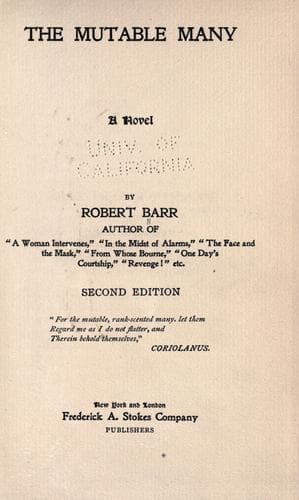
Factories -- Fiction; London (England) -- Fiction; Love stories; Strikes and lockouts -- Fiction
“Guaranteed! What does a master’s guarantee amount to? We’re going to
win this strike, and then where will you new-comers be? You know what
happens when the men go back. Not one of you will be left in the shops.
Suppose you do get good wages for a few weeks, what will be the benefit
in the end? A permanent situation at even lower wages would be better.”
“Who says it wouldn’t? But I haven’t the permanent situation, you see.”
“Now you are talking sense. Are you a member of the Union?”
“I was. I had a row with the foreman, and he gave me the sack.”
“In whose shop was that?”
“At Smighden’s.”
“I don’t know it. What wages were you getting there?”
“Thirty shillings a week.”
“Do you know Markham, Sarbury & Company, of Bolton?”
“Yes.”
“Would you be satisfied with thirty shillings a week there?”
“Yes; if I could be sure of getting it.”
“You can be sure of it. I will telegraph to the foreman this minute, and
we’ll have an answer before we finish eating. He has promised to find
me places for three men, and I haven’t sent him one yet. But don’t say a
word to any one here, for I want to keep the other two places for Bolton
men if they come.”
“I’ll not go back to this shop at all if I can be sure of a place in
Bolton.”
And so it came about that Sartwell lost his hundredth cog, and the cog
never thought it worth his while to give his late master even a word of
explanation. He left on the first train for Manchester.
This kind of thing happened several times before Sartwell fully realized
the method in Marsten’s action. He thought at first that Marsten had
been merely lucky in buying off a man at the very time when such a
purchase would block all progress. It was like pulling the linchpin from
one of the axles of a wagon. The manager wrote to his fellow-managers in
different parts of the country, and warned them that their foremen were
giving places to employees from the works of Monkton & Hope, and he
received answers saying they would do all they could to prevent such
transplanting; but, as it was difficult to trace where a man went,
when so few of them were deported, the warning came to nothing. If
a wholesale exodus had been attempted, Sartwell, with the aid of his
fellow-managers, might have done something to prevent its success; but
the very homoeopathic nature of Marsten’s remedy made it difficult to
cope with. By this time the feeling that he was a beaten man came over
Sartwell, and, although he said nothing and sought sympathy from no one,
it aged him more than years of toil had done. His daughter, now home
from school, saw with helpless grief the deep lines care was ploughing
in his rugged face.
Public-domain text, read in full here on John Shaqi.
Reviews
Reviews
No reviews yet
Be the first to share your thoughts on this work.
Elsewhere in the archive
Join the Discussion
Join the discussion
Sign in to leave a comment or review.
Sign InorCreate an account