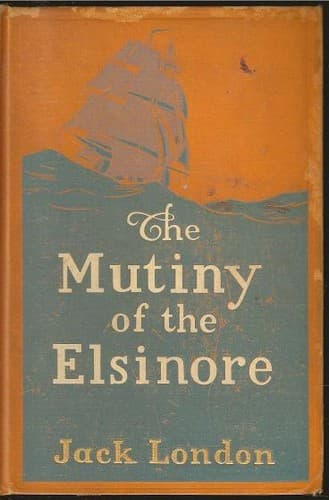
Water was everywhere. The _Elsinore_ was rushing through a blurring
whirr of water. Seas creamed and licked the poop-deck edge, now to
starboard, now to port. High in the air, over-towering and perilously
down-toppling, following-seas pursued our stern. The air was filled
with spindrift like a fog or spray. No officer of the watch was in
sight. The poop was deserted, save for two helmsmen in streaming
oilskins under the half-shelter of the open wheel-house. I nodded good
morning to them.
One was Tom Spink, the elderly but keen and dependable English sailor.
The other was Bill Quigley, one of a forecastle group of three that
herded uniquely together, though the other two, Frank Fitzgibbon and
Richard Giller, were in the second mate’s watch. The three had proved
handy with their fists, and clannish; they had fought pitched
forecastle battles with the gangster clique and won a sort of
neutrality of independence for themselves. They were not exactly
sailors—Mr. Mellaire sneeringly called them the “bricklayers”—but they
had successfully refused subservience to the gangster crowd.
To cross the deck from the chart-house to the break of the poop was no
slight feat, but I managed it and hung on to the railing while the wind
stung my flesh with the flappings of my pyjamas. At this moment, and
for the moment, the _Elsinore_ righted to an even keel, and dashed
along and down the avalanching face of a wave. And as she thus righted
her deck was filled with water level from rail to rail. Above this
flood, or knee-deep in it, Mr. Pike and half-a-dozen sailors were
bunched on the fife-rail of the mizzen-mast. The carpenter, too, was
there, with a couple of assistants.
The next roll spilled half a thousand tons of water outboard sheer over
the starboard-rail, while all the starboard ports opened automatically
and gushed huge streams. Then came the opposite roll to port, with a
clanging shut of the iron doors; and a hundred tons of sea sloshed
outboard across the port-rail, while all the iron doors on that side
opened wide and gushed. And all this time, it must not be forgotten,
the _Elsinore_ was dashing ahead through the sea.
The only sail she carried was three upper-topsails. Not the tiniest
triangle of headsail was on her. I had never seen her with so little
wind-surface, and the three narrow strips of canvas, bellied to the
seemingness of sheet-iron with the pressure of the wind, drove her
before the gale at astonishing speed.
Public-domain text, read in full here on John Shaqi.
Reviews
Reviews
No reviews yet
Be the first to share your thoughts on this work.
Elsewhere in the archive
Join the Discussion
Join the discussion
Sign in to leave a comment or review.
Sign InorCreate an account