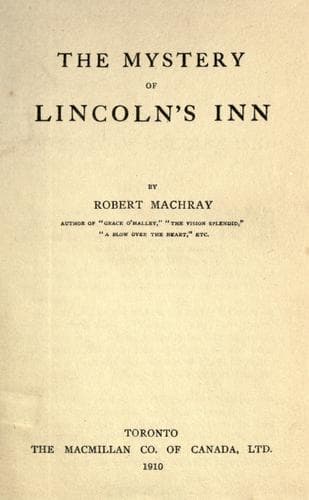
Detective and mystery stories; Embezzlement -- Fiction; England -- Fiction
"In the churchyard. Come, let me show you his tomb."
As they went together down the single street of which Camajore consists,
towards the church, Gilbert said his father had specially charged him to
discuss with Ucelli what was to be done with the effects Silwood had
left behind him, and which were now in the Syndic's possession.
"Yes; when we return to my house I will show you them. There is not
much--some letters, a pocket-book containing a few pounds in notes, and
some gold and silver, the money amounting in all to about twenty pounds
English. There is also a watch, and I believe that is all. As Syndic I
have kept them, but, of course, am very willing to hand them over to the
proper authority. Indeed, I shall be very glad to do so."
By this time the two men had reached the grave-yard. On entering it,
Ucelli pointed to the numerous mounds on which the earth was
comparatively fresh.
"The cholera," he said; "it was the cholera! Alas! it was the will of
God!"
Gilbert nodded, his face set and stern.
"See," said the Syndic, when they had advanced a few steps, pointing to
a mound, "that is where the body of M. Silwood lies."
In appearance this mound differed in no respect from the rest.
"Do you think of erecting a monument to M. Silwood?" asked Ucelli. "If
so, I can have it made for you here."
"No," replied Gilbert, shortly. "What I intend to do is to remove the
body to England."
"The body removed to England!" said the Syndic, who had given a great
start on hearing Gilbert's statement.
"Yes; that seems best," remarked Gilbert, watching Ucelli keenly, and
noticing his surprise.
"But think! he died of cholera! The law will forbid--it does
forbid--the body of one who has died of cholera from being removed. It
is therefore impossible, I regret to tell you, for you to carry out your
intention. I am very sorry, for your idea is a natural one; but the law,
monsieur, the law will not permit it."
"There's a good deal of cleverness about this plot," thought Gilbert.
But he said to Ucelli, "I am very sorry to hear this. Is there no way of
getting over the difficulty?"
"No way, monsieur, none whatever. It is impossible. It is the law. And
it is also common sense," he added, smoothly and courteously. "On
reflection you must admit it."
"Suppose the law did not forbid it," asked Gilbert, "what should I have
to do in order to be allowed to remove the body?"
"The authorities must give permission."
"What authorities?"
"At Rome. I can do nothing in such a matter; it is too high for me."
"Then to Rome I must go," said Gilbert to himself. But he talked no more
on this subject with the Syndic, who accordingly thought Gilbert was
satisfied, and had abandoned any idea he might have had of removing the
body to England.
Public-domain text, read in full here on John Shaqi.
Reviews
Reviews
No reviews yet
Be the first to share your thoughts on this work.
Elsewhere in the archive
Join the Discussion
Join the discussion
Sign in to leave a comment or review.
Sign InorCreate an account