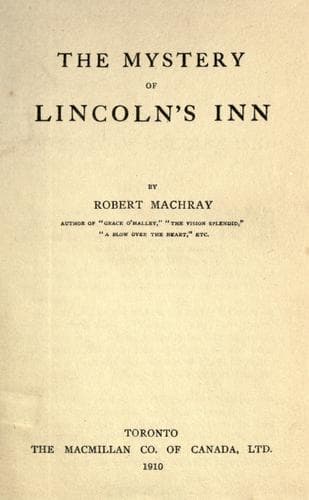
Detective and mystery stories; Embezzlement -- Fiction; England -- Fiction
Then they went to the office of the Syndic, and there Gilbert was shown
the effects to which allusion had already been made. In addition to the
articles and sums of money mentioned by Ucelli, there were two leather
valises and some clothing. The Syndic explained that it had been
necessary to burn most of the clothes that had belonged to Silwood.
"If you would like to examine or look into anything," said Ucelli, "you
are at liberty to do so. It is, perhaps, slightly irregular, as you are
not a relative of the deceased, but I make no objection."
"Everything has been carefully planned," thought Gilbert, as he mentally
took note of the various objects. "They have succeeded in making the
thing look perfectly natural and what would be expected in the
circumstances. The watch, the clothes, the money, the letters, the
travelling-bags, are just what one would expect to find as the dead
man's effects, if he had been a dead man."
"To give you these, I shall require to have an order from the
Government," said Ucelli.
"The Government at Rome?"
"Yes."
"I suppose, then," said Gilbert, "I had better go on to Rome?"
"That is your best course," agreed Ucelli, without suspicion, and he
bade Gilbert _bon-voyage_.
CHAPTER XXXI
While Ucelli, Syndic of Camajore, was congratulating himself he had
played his part so well that he had as little to fear from Gilbert
Eversleigh as from the detective Brydges, or the journalist Westgate,
who had come to make inquiries respecting the death of Cooper Silwood,
Gilbert, on the other hand, was congratulating himself that, owing to
the final turn of their conversation, his going on to Rome seemed to the
Syndic the right and proper thing to be done.
If Ucelli had suspected Gilbert had a twofold object in view, he would
have taken all the means in his power to prevent him from attaining it;
but he thought Gilbert had dropped any idea he might have entertained of
opening Silwood's grave, and now had no other end than to obtain the
necessary authorization by which Silwood's effects would be handed to
him. The Syndic's mind, therefore, was at ease.
On his way to the Italian capital, Gilbert considered the situation. He
did not doubt that the law with regard to the removal of a
cholera-infected body was what Ucelli stated, and he foresaw it might be
difficult, perhaps impossible, for him to accomplish his purpose. He
hoped, however, that he might put such stress on his belief that in
Silwood's grave was no body at all, as would lead the British Ambassador
to make strong representations that in this case there could be no
danger in opening the grave.
On his arrival in Rome, Gilbert called at the Embassy immediately, only
to be told that Lord Prestonkirk, the Ambassador, was not in the city,
but was staying at a house he had in the mountains many miles away.
Thither, accordingly, Gilbert went, the journey involving the loss of a
day, at which he fretted not a little.
Public-domain text, read in full here on John Shaqi.
Reviews
Reviews
No reviews yet
Be the first to share your thoughts on this work.
Elsewhere in the archive
Join the Discussion
Join the discussion
Sign in to leave a comment or review.
Sign InorCreate an account