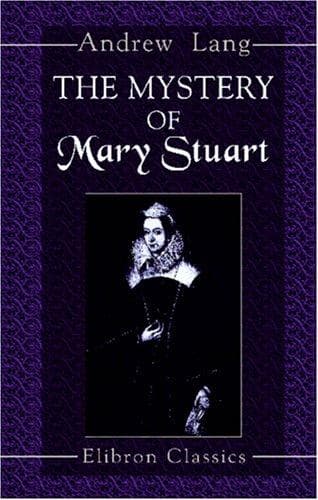
Mary, Queen of Scots, 1542-1587; Queens -- Scotland -- Biography; Scotland -- History -- Mary Stuart, 1542-1567
And why was Lethington thus ‘extremely opposed’? First, Mary, if free,
would join Bothwell, his deadly foe. Secondly, he knew from her own lips
that Mary knew his share in Darnley’s murder, and had proof. While she
lived, the sword hung over Lethington. He, therefore, insisted on her
imprisonment in a place whence escape should have been impossible. He is
even said to have advised that she should be secretly strangled. Years
later, when time had brought in his revenges, and Lethington and Kirkcaldy
were holding the Castle for Mary, her last hope, Lethington explained his
change of sides in a letter to his opponent, Morton. Does Morton hate him
because he has returned to the party of the Queen? He had advised Morton
to take the same course, ‘being assured that, with time, she would recover
her liberty (as yet I have no doubt but she will). I deemed it neither
wisdom for him nor me to deserve particular ill will at her hands.’ This
was a frank enough explanation of his own change of factions. If ever Mary
came to her own, Lethington dreaded her feud. We shall see that as soon as
she was imprisoned, Lethington affected to be her secret ally. Morton
replied that ‘it was vain in Lethington to think that he could deserve
more particular evil will at Mary’s hands than he had deserved
already.’[210]
Lethington could not be deeper in guilt towards Mary than he was, despite
his appearance of friendship. The ‘evil will’ which he had incurred was
‘particular,’ and could not be made worse. In the same revolution of
factions (1570-73) Randolph also wrote to Lethington and Kirkcaldy asking
them why they had deserted their old allies, Morton and the rest, for the
Queen’s party. ‘You yourselves wrote against her, and were the chiefest
causes of her apprehension, and imprisonment’ (at Loch Leven), ‘and
dimission of her crown.... So that you two were her chiefest occasion of
all the calamities, _as she hath said_, that she is fallen into. You, Lord
of Lethington, _by your persuasion and counsel to apprehend her, to
imprison her, yea, to have taken presently the life from her_.’[211] To
this we shall return.
When we add to this testimony Mary’s hatred of Lethington, revealed in
Nau’s MS., a hatred which his death could not abate, though he died in her
service, we begin to understand. Sir James Melville and Throckmorton were
(as we shall see) deluded by the ‘dulce manner’ of Lethington. But, in
truth, he was Mary’s worst enemy, till his bolt was shot, while hers
remained in her hands. Then Lethington, in 1569, went over to her party,
as a charge of Darnley’s murder, urged by his old partisans, was hanging
over his head.
Meanwhile, after Mary’s surrender at Carberry, the counsel of Lethington
prevailed. She was hurried to Loch Leven, after two dreadful days of tears
and frenzied threats and entreaties, and was locked up in the Castle on
the little isle, the Castle of her ancestral enemies, the Douglases. There
she awaited her doom, ‘the fiery death.’
IX
Public-domain text, read in full here on John Shaqi.
Reviews
Reviews
No reviews yet
Be the first to share your thoughts on this work.
Elsewhere in the archive
Join the Discussion
Join the discussion
Sign in to leave a comment or review.
Sign InorCreate an account