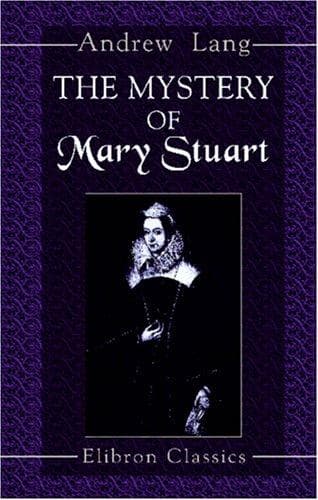
Mary, Queen of Scots, 1542-1587; Queens -- Scotland -- Biography; Scotland -- History -- Mary Stuart, 1542-1567
If he did not arrive till noon on the 25th, all is clear, and Letter I.
falls into its proper place as really Letter II., and is easily
intelligible. Its contents run thus: Mary, who left Bothwell on January
21, upbraids him for neglect of herself. She expected news, and an answer
to her earlier Letter (II.) dispatched on the 23rd, and has received none.
The news she looked for was to tell her what she ought to do. If no news
comes, she will, ‘according to her commission,’ take Darnley to
Craigmillar on Monday: she actually did take him on Monday, as far as
Callendar. But she is clearly uncertain, when she writes on January 25, as
to whether Craigmillar has been finally decided upon. A possible
alternative was present to her mind. After describing the amorous Darnley,
and her own old complaint, a pain in the side, she says, ‘If Paris doth
bring back unto me that for which I have sent, it should much amend me.’
News of Bothwell, brought by Paris, will help to cure her. She had
expected news on the day before, January 24.
Nothing could be more natural. Mary and Bothwell had parted on January 21.
She should have heard from him, if he were a punctual and considerate
lover, on the 23rd; at latest Paris should have brought back on the 24th
his reply to her long letter, numbered II. but really I. But the morning
of ‘this Saturday’ (the 25th) has dawned, and brought no news, no answer,
no Paris. (That is, if Paris either slept in Edinburgh on the night of the
24th, or somewhere on the long dark moorland road.) Impatient of three
days’ retarded news, ignorant as to whether Craigmillar is fixed on for
Darnley, or not, without a reply to the letter carried to Bothwell by
Paris (Letter II.), Mary writes Letter I. on January 25. It is borne by
her chamberlain, Beaton, who is going on legal business to Edinburgh.
Nothing can be simpler or more easily intelligible.
There remains a point of which much has been made. In the English, but not
in the Scots translation, Mary says, ‘_I send this present to Lethington_,
to be delivered to you by Beaton.’ The Scots is ‘I send this be Betoun,
quha gais’ to his legal business. Nothing about Lethington. On first
observing this, I inferred--(_a_) that Lethington had the reference to
himself cut out of the Scots version, as connecting him with the affair.
(_b_) I inferred that Lethington could have had no hand in forging the
original French (if forging there was), because he never would have
allowed his name to appear in such a connection. Later I observed that
several Continental critics had made similar inferences.[335] But all this
is merely one of the many mare’s-nests of criticism. For proof of the
futility of such deductions see Appendix E, ‘The Translation of the Casket
Letters.’
Public-domain text, read in full here on John Shaqi.
Reviews
Reviews
No reviews yet
Be the first to share your thoughts on this work.
Elsewhere in the archive
Join the Discussion
Join the discussion
Sign in to leave a comment or review.
Sign InorCreate an account