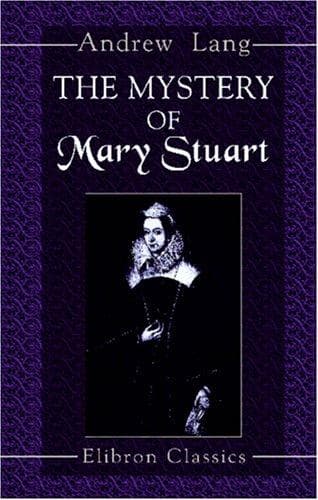
Mary, Queen of Scots, 1542-1587; Queens -- Scotland -- Biography; Scotland -- History -- Mary Stuart, 1542-1567
It needs much good will, or rather needs much ill will, to regard this
Letter as an inducement to Bothwell to make Lord Robert draw on Darnley.
Mary, without Bothwell’s help, could have summoned Lord Robert on any
pretext, and then set him and Darnley by the ears. The date of Mary’s
attempt to end Darnley by her brother’s sword, Buchanan places ‘about
three days before the King was slain.’ ‘Cecil’s Journal,’ as we saw,
places it on February 8. Darnley was murdered after midnight of February
9. Paris said that, to the best of his memory, he carried letters on the
Friday night, the 7th, from Mary, at Kirk o’ Field, to Bothwell. On
Saturday, Mary told her attendants of the quarrel between Darnley and Lord
Robert. ‘Lord Robert,’ she said, ‘had good means of killing the King at
that moment, for there was then nobody in the chamber to part them but
herself.’ These are rather suspicious confessions.[362] Moreover, Lennox,
in his MSS., says that Moray was present at the incident, and could bear
witness at Westminster. The statement of Paris is confused: he carried
letters both on Thursday and Friday nights (February 6 and 7), and his
declaration about all this affair is involved in contradictions.
According to the confession of Hay of Tala, it was on February 7 that
Bothwell arranged the method by gunpowder. When he had just settled that,
Mary, _ex hypothesi_, disturbed him with the letter on the scheme of using
Lord Robert and a chance scuffle: an idea suggested to her by what she had
extracted, that very night, from Darnley--namely, the warning whispered to
him by Lord Robert. She thinks that, if confronted, they will fight,
Darnley will fall, and this will serve ‘pour excuser votre affaire,’ as
the Letter says. Buchanan adds in his ‘History,’ that Bothwell was present
to kill anybody convenient (fol. 350). It was a wildly improbable scheme,
especially if Mary, as Buchanan says, called in Moray to stop the quarrel,
or share the blame, or be killed by Bothwell.
That the Letter, with some others of the set, is written in an odd,
affected style, does not yield an argument either to the attack or the
defence. If it is unlikely that Mary practised two opposite kinds of
style, it is also unlikely that a forger, or forgers, would venture on
attributing to her the practice. To this topic there will be opportunities
of returning.
LETTER IV
Public-domain text, read in full here on John Shaqi.
Reviews
Reviews
No reviews yet
Be the first to share your thoughts on this work.
Elsewhere in the archive
Join the Discussion
Join the discussion
Sign in to leave a comment or review.
Sign InorCreate an account