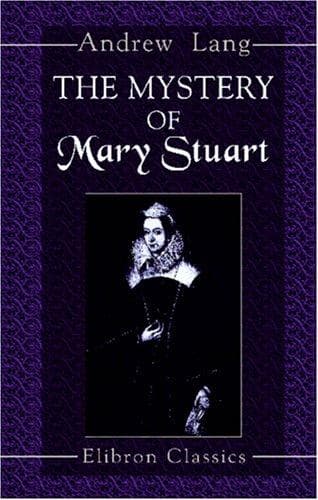
Mary, Queen of Scots, 1542-1587; Queens -- Scotland -- Biography; Scotland -- History -- Mary Stuart, 1542-1567
This Letter merely concerns somebody’s distrust of a maid of Mary’s. The
maid is about to be married, perhaps to Bastian, but there is nothing
said that identifies either the girl, or the recipient of the letter. Its
tone, however, is that of almost abjectly affectionate submission, and
there is a note of a common end, to which the writer and the recipient are
working, _ce à quoy nous tandons tous deux_. If Mary dismisses the maid,
she, in revenge, may reveal her scheme. The writer deprecates the
suspicions of her correspondent, and all these things mark the epistle as
one in this series. As it proves nothing against Mary, beyond affection
for somebody, a common aim with him, and fear that the maid may spoil the
project, there could be no reason for forging the Letter. A transcript of
the original French is in the Record Office.[363] The translators have
blundered over an important phrase from ignorance of French.[364]
LETTER V
On the night of April 19, 1567, Bothwell obtained the signatures of many
nobles to ‘Ainslie’s Band,’ as it is called, a document urging Mary to
marry Bothwell.[365] On Monday, April 21, Mary went to Stirling, to see
her child. She was suspected of intending to hand him over to Bothwell. If
she meant to do this, her purpose was frustrated. On Wednesday, April 23,
she went to Linlithgow, and on Thursday, April 24, was seized by Bothwell,
near Edinburgh, and carried to Dunbar. This Letter, if genuine, proves her
complicity; and is intended to prove it, if forged. On the face of it, the
Letter was written at Stirling. Mary regrets Bothwell’s confidence in an
unworthy person, Huntly, the brother of his wife. Huntly has visited her,
and, instead of bringing news as to how and when the abduction is to
managed, has thrown cold water on the plot. He has said that Mary can
never marry a married man who abducts her, and that the Lords _se
dédiroient_, which the Scots translator renders ‘the Lordis wald unsay
themselves, and wald deny that they had said.’ The reference is to their
acquiescence in the Ainslie band of April 19. Mary, as usual, displays
jealousy of Bothwell, who has ‘two strings to his bow,’ herself and his
wedded wife. The Letter implies that, for some reason, Mary and Bothwell
had not arranged the details of the abduction before they separated. A
transcript of the original French is at Hatfield; the English translation,
also at Hatfield, is not from the French, but is a mere Anglicising of the
Scots version. Oddly enough the French copy at Hatfield, unlike the rest,
is in a Roman hand, such as Mary wrote. The hand resembles that of the
copyist of the Casket Sonnets in the Cambridge (Lennox) MSS., and that of
Mary Beaton, but it is not Mary Beaton’s hand.
LETTER VI
This Letter still deals with the manner of the _enlèvement_. Mary is now
reconciled to the idea of trusting Huntly.
She advises Bothwell as to his relations with the Lords. The passage
follows:--
Public-domain text, read in full here on John Shaqi.
Reviews
Reviews
No reviews yet
Be the first to share your thoughts on this work.
Elsewhere in the archive
Join the Discussion
Join the discussion
Sign in to leave a comment or review.
Sign InorCreate an account