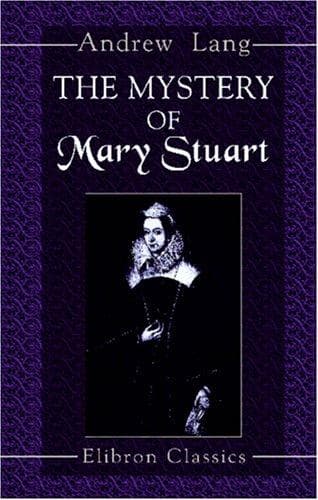
Mary, Queen of Scots, 1542-1587; Queens -- Scotland -- Biography; Scotland -- History -- Mary Stuart, 1542-1567
Outraged and harassed, broken, at last, in health, in constant pain,
expressing herself in hysterical outbursts of despair and desire for
death, Mary needed no passion for Bothwell to make her long for freedom
from the young fool. From his sick-bed in Glasgow, as we shall see, he
sent, by a messenger, a cutting verbal taunt to the Queen; so his own
friends declare, they who call Darnley ‘that innocent lamb.’ It is not
wonderful if, in an age of treachery and revenge, the character of Mary
now broke down. ‘I would not do it to him for my own revenge. My heart
bleeds at it,’ she says to Bothwell, in the Casket Letter II., if that was
written by her. But, whatever her part in it, the deed was done.
Of Bothwell, the third protagonist in the tragedy of Three, we have no
portrait, and but discrepant descriptions. They who saw his body, not yet
wholly decayed, in Denmark, reported that he must have been ‘an ugly
Scot,’ with red hair, mixed with grey before he died. Much such another
was the truculent Morton.[8] Born in 1536 or 1537, Bothwell was in the
flower of his age, about thirty, when Darnley perished. He was certainly
not old enough to have been Mary’s father, as Sir John Skelton declared,
for he was not six years her senior. His father died in 1556, and Bothwell
came young into the Hepburn inheritance of impoverished estates, high
offices, and wild reckless blood. According to Buchanan, Bothwell, in
early youth, was brought up at the house of his great-uncle, Patrick
Hepburn, Bishop of Moray, who certainly was a man of profligate life. It
is highly probable that Bothwell was educated in France.
‘Blockish’ or not, Bothwell had the taste of a bibliophile. One of two
books from his library, well bound, and tooled with his name and arms, is
in the collection of the University of Edinburgh. Another was in the
Gibson Craig Library. The works are a tract of Valturin, on Military
Discipline (Paris, 1555, folio), and French translations of martial
treatises attributed to Vegetius, Sextus Julius, and Ælian, with a
collection of anecdotes of warlike affairs (Paris, 1556, folio). The
possession of books like these, in such excellent condition, is no proof
of doltishness. Moreover, Bothwell appears to have read his ‘CXX Histoires
concernans le faite guerre.’ The evidence comes to us from a source which
discredits the virulent rhetoric of Buchanan’s ally.
Public-domain text, read in full here on John Shaqi.
Reviews
Reviews
No reviews yet
Be the first to share your thoughts on this work.
Join the Discussion
Join the discussion
Sign in to leave a comment or review.
Sign InorCreate an account