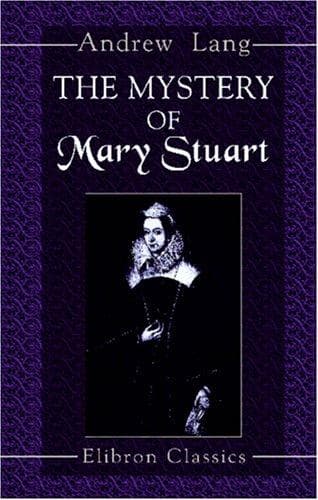
Mary, Queen of Scots, 1542-1587; Queens -- Scotland -- Biography; Scotland -- History -- Mary Stuart, 1542-1567
In an age when many gentlemen and ladies could not sign their names,
Bothwell wrote, and wrote French, in a firm, yet delicate Italic hand, of
singular grace and clearness.[11] His enemies accused him of studying none
but books of Art Magic in his youth, and he may have shared the taste of
the great contemporary mathematician, Napier of Merchistoun, the inventor
of Logarithms. Both Mary’s friends and enemies, including the hostile
Lords in their proclamations, averred that Bothwell had won her favour by
unlawful means, philtres, witchcraft, or what we call Hypnotism. Such
beliefs were universal: Ruthven, in his account of Riccio’s murder, tells
us that he gave Mary a ring, as an antidote to poison (not that _he_
believed in it), and that both she and Moray took him for a sorcerer. On a
charge of sorcery did Moray later burn the Lyon Herald, Sir William
Stewart, probably basing the accusation on a letter in which Sir William
confessed to having consulted a prophet, perhaps Napier of Merchistoun,
the father, not the inventor of Logarithms.[12] Quite possibly Bothwell
may really have studied the Black Art in Cornelius Agrippa and similar
authors. In any case it is plain that, as regards culture, the author of
_Les Affaires du Conte de Boduel_, the man familiar with the Court of
France, where he had held command in the Scots Guards, and had probably
known Ronsard and Brantôme, must have been a _rara avis_ of culture among
the nobles at Holyrood. So far, then, Mary’s love for him, if love she
entertained, was the reverse of ‘incredible.’ It did not need to be
explained by a common possession of ‘extreme vices.’ The author, as usual,
overstates his case, and proves too much: Lesley admits that Bothwell was
handsome, an opinion emphatically contradicted by Brantôme.
Bothwell had the charm of recklessness to an unexampled degree. He was
fierce, passionate, unyielding, strong, and, in the darkest of Mary’s
days, had been loyal. He had won for her what Knollys tells us that she
most prized, victory. A greater contrast could not be to the false
fleeting Darnley, the bully with ‘a heart of wax.’ In him Mary had more
than enough of bloom and youthful graces: she could master him, and she
longed for a master. If then she loved Bothwell, her love, however wicked,
was not unnatural or incredible. He had been loved by many women, and had
ruined all of them.
Public-domain text, read in full here on John Shaqi.
Reviews
Reviews
No reviews yet
Be the first to share your thoughts on this work.
Join the Discussion
Join the discussion
Sign in to leave a comment or review.
Sign InorCreate an account