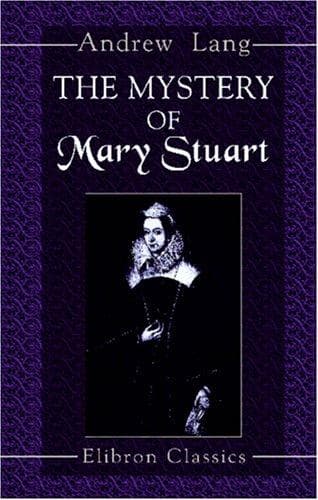
Mary, Queen of Scots, 1542-1587; Queens -- Scotland -- Biography; Scotland -- History -- Mary Stuart, 1542-1567
Most inscrutable of the persons in the play is Bothwell’s wife, Lady Jane
Gordon, a daughter of Huntly, the dead and ruined Cock of the North. If we
may accept the Casket Sonnets, Lady Jane, a girl of twenty, resisted her
brother’s scheme to wed her to Bothwell. She preferred some one whom the
sonnet calls ‘a troublesome fool,’ and a note, in the Lennox Papers,
informs us that her first love was Ogilvy of Boyne, who consoled himself
with Mary Beaton. Still following the sonnets, we learn that the young
Lady Bothwell dressed ill, but won her wild husband’s heart by literary
love letters plagiarised from ‘some illustrious author.’ The existing
letters of the lady, written after the years of storm, are businesslike,
and deal with business. She consented to her divorce for a valuable
consideration in lands which she held till her death, in the reign of
Charles I. According to general opinion, Bothwell, as we shall see,
greatly preferred her to the Queen, and continued to live with her after
the divorce. Lady Bothwell kept the dispensation which enabled her to
marry Bothwell, though he was divorced from her for the want of it. She
married the Earl of Sutherland in 1573, and, after his death, returned _à
ses premiers amours_, wedding her old true love who had wooed her in her
girlhood, Ogilvy of Boyne. Their conversation must have been rich in
curious reminiscences. The loves and hatreds of their youth were extinct;
the wild hearts of Bothwell, Mary, Mary Beaton, Lethington, Darnley, and
the rest, had long ceased to beat, and these two were left, Darby and
Joan, alone in a new world.
II
_THE MINOR CHARACTERS_
Having sketched the chief actors in this tragedy, we may glance at the
players of subordinate parts. They were such men as are apt to be bred
when a religious and social Revolution has shaken the bases of morality,
when acquiescence in theological party cries confers the title of ‘godly:’
when the wealth of a Church is to be won by cunning or force, and when
feudal or clan loyalty to a chief is infinitely more potent than fidelity
to king, country, and the fundamental laws of morality. The Protestants,
the ‘godly,’ accused the Idolaters (the Catholics) of throwing their sins
off their shoulders in the confessional, and beginning anew. But the
godly, if naturally ruffians, consoled and cleared themselves by
repentances on the scaffold, and one felt assured, after a life of crime,
that he ‘should sup with God that night.’
Public-domain text, read in full here on John Shaqi.
Reviews
Reviews
No reviews yet
Be the first to share your thoughts on this work.
Join the Discussion
Join the discussion
Sign in to leave a comment or review.
Sign InorCreate an account