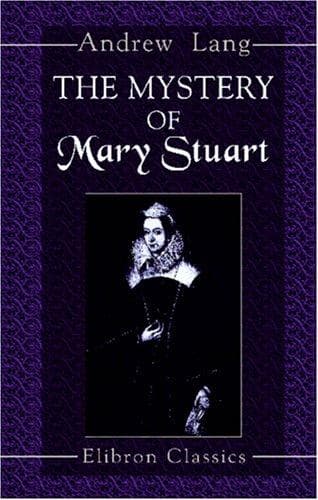
Mary, Queen of Scots, 1542-1587; Queens -- Scotland -- Biography; Scotland -- History -- Mary Stuart, 1542-1567
The present volume is not a Defence of Mary’s innocence. My object is to
show, how the whole problem is affected by the discovery of the Lennox
Papers, which admit us behind the scenes, and enable us to see how Mary’s
prosecutors, especially the Earl of Lennox, the father of her murdered
husband, got up their case. The result of criticism of these papers is
certainly to reinforce Mr. Hosack’s argument, that there once existed a
forged version of the long and monstrous letter to Bothwell from Glasgow,
generally known as ‘Letter II.’ In this book, as originally written, I had
myself concluded that Letter II., as it stands, bears evidence of
garbling. The same is the opinion of Dr. Bresslau, who accepts the other
Casket Papers as genuine. The internal chronology of Letter II. is
certainly quite impossible, and in this I detected unskilled dove-tailing
of genuine and forged elements. But I thought it advisable to rewrite the
first half of the Letter, in modern English, as if it were my own
composition, and while doing this I discovered the simple and ordinary
kind of accident which may explain the dislocation of the chronology, and
remove the evidence to unskilled dove-tailing and garbling. In the same
spirit of rather reluctant conscientiousness, I worked out the scheme of
dates which makes the Letter capable of being fitted into the actual
series of events. Thus I am led, though with diffidence, to infer that,
though a forged version of Letter II. probably once existed, the Letter
may be, at least in part, a genuine composition by the Queen. The fact,
however, does not absolutely compel belief, and, unless new manuscripts
are discovered, may always be doubted by admirers of Mary.
Sir John Skelton, in his ‘Maitland of Lethington,’ regarded the supposed
falsification of Letter II. as an argument against all the Casket Letters
(‘false in one thing, false in all’). But it is clear that forgery may be
employed to strengthen the evidence, even of a valid cause. If Mary’s
enemies deemed that the genuine evidence which they had collected was
inadequate, and therefore added evidence which was not genuine, that
proves their iniquity, but does not prove Mary’s innocence. Portions of
the Letter II., and of some of the other Letters, have all the air of
authenticity, and suffice to compromise the Queen.
This inquiry, then, if successfully conducted, does not clear Mary, but
solves some of the darkest problems connected with her case. I think that
a not inadequate theory of the tortuous and unintelligible policy of
Maitland of Lethington, and of his real relations with Mary, is here
presented. I also hope that new light is thrown on Mary’s own line of
defence, and on the actual forgers or contaminators of her Letters, if the
existence of such forgery or contamination is held to be possible.
Public-domain text, read in full here on John Shaqi.
Reviews
Reviews
No reviews yet
Be the first to share your thoughts on this work.
Join the Discussion
Join the discussion
Sign in to leave a comment or review.
Sign InorCreate an account