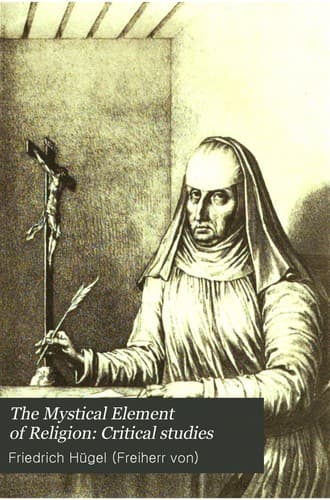
The Mystical Element of Religion, as studied in Saint Catherine of Genoa and her friends, Volume 2 (of 2)Hügel, Friedrich, Freiherr von
Religion
The Mystical Element of Religion, as studied in Saint Catherine of Genoa and her friends, Volume 2 (of 2)
Hügel, Friedrich, Freiherr von
Catherine, of Genoa, Saint, 1447-1510
“Seeing such Beauty, I have been drawn out of myself … and the heart
now gets undone, melted as though it were wax, and finds itself again,
with the likeness of Christ upon it,” v. 11, must have stimulated, by
its first part, some of her own experiences, and will, by its second
part, taken literally, have helped on the fantastic expectations of
her attendants. “Love rises to such ardour, that the heart seems to
be transfixed as with a knife,” v. 14, no doubt both expressed an
experience of Jacopone and helped to constitute the form of a similar
experience on the part of Catherine. “As iron, which is all on fire,
as dawn, made resplendent by the sun, lose their own form (nature) and
exist in another, so is it with the pure mind, when clothed by Thee, O
Love,” v. 21, contains ideas, (all but the symbol of clothing,) very
dear to Catherine. But the astonishingly daring words: “Since my soul
has been transformed into Truth, into Thee, O Christ alone, into Thee
Who art tender Loving,--not to myself but to Thee can be imputed what I
do. Hence, if I please Thee not, Thou dost not please Thine Own Self,
O Love!” v. 22, remain unechoed by her, no doubt because her states
shift from one to another, and she wisely abstains from pushing the
articulation of any one of them to its own separate logical limit.
“Thou wast born into the world by love and not by flesh, O Love
become Man (_humanato Amore_),” v. 27, is like her in its interesting
persistence in the “Love” (not “Lover”) designation, but is unlike her
in its definite reference to the historic Incarnation. “Love, O Love,
Jesus, I have reached the haven,” v. 32, is closely like her, all but
the explicit mention of the historic name; and “Love, O Love, Thou art
the full-orbed circle,” “Thou art both warp and woof,” beginning and
end, material and transforming agency, v. 33, is Catherine’s central
idea, expressed in a form much calculated to impress it upon her.
Public-domain text, read in full here on John Shaqi.
Reviews
Reviews
No reviews yet
Be the first to share your thoughts on this work.
Elsewhere in the archive
Join the Discussion
Join the discussion
Sign in to leave a comment or review.
Sign InorCreate an account