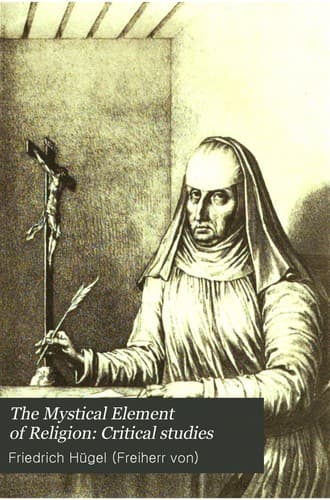
The Mystical Element of Religion, as studied in Saint Catherine of Genoa and her friends, Volume 2 (of 2)Hügel, Friedrich, Freiherr von
Religion
The Mystical Element of Religion, as studied in Saint Catherine of Genoa and her friends, Volume 2 (of 2)
Hügel, Friedrich, Freiherr von
Catherine, of Genoa, Saint, 1447-1510
Loda LXXIX, “Of the Divine Love and its Praises,” has evidently much
influenced her. “O joyous wound, delightful wound, gladsome wound, for
him who is wounded by Thee, O Love!” “O Love, divine Fire! Love full
of laughter and playfulness!” “O Love, sweet and suave; O Love, Thou
art the key of heaven! Ship that Thou art, bring me to port and calm
the tempest,” vv. 3, 6, 16. All this we have found reproduced in her
similes and experiences. “Love, bounteous in spending Thyself; Love
with widespread tables!” “Love, Thou art the One that loves, and the
Means wherewith the heart loves Thee!” vv. 24, 26. These verses give us
the wide, wide world outlook, the connection between Love and the Holy
Eucharist, and the identity of the Subject, Means, and Object of Love,
which are all so much dwelt upon by Catherine.
Loda LXXXI is interesting by the way in which, although treating of
“the love of Christ upon the Cross,” it everywhere apostrophizes Love
and not the Lover, and treats the former, again like Catherine, as a
kind of boundless living substance; indeed v. 17 must have helped to
suggest one of her favourite conceptions: “O great Love, greater than
the great sea! Oh! the man who is drowned within it, under it, and with
it all around him, whilst he knows not where he is!”
Loda LXXXIII has two touches dear to Catherine. “O Love, whose name is
‘I love’--the plural is never found,” v. 5,--a saying which evidently
is directed, not against a social conception of religion, but against
a denial of the Divine Love being Source as well as Object of our
love; and “I did not love Thee with any gain to myself, until I loved
Thee for Thine own sake,” v. 15,--a declaration of wondrous depth and
simplicity.
4. _Lode LXXXVIII, LXXXIX, LXXXX, LXXXXVIII, LXXXXIX._
The great Loda LXXXVIII, “How the soul complains to God concerning
the excessive ardours of the love infused into it,” contains numerous
touches which have been interestingly responded to or ignored by
Catherine. “All my will is on fire with Love, is united, transformed
(into It); who can bear such Love? Nor fire nor sword can part the
loving soul and her Love; a thing so united cannot be divided; neither
suffering nor death can henceforth mount up to that height where the
soul abides in ecstasy,” vv. 5, 6: a combination of St. Paul and
Plotinus, quite after Catherine’s heart. But “the light of the sun
appears to me obscure, now that I see that resplendent Countenance,”
v. 7, has an anthropomorphic touch to which she does not respond;
and “I have given all my heart, that it may possess that Lover who
renews me so,--O Beauty ancient and ever new!” v. 10, has the personal
designation “Lover,” which, again, is alien to her vocabulary.
Public-domain text, read in full here on John Shaqi.
Reviews
Reviews
No reviews yet
Be the first to share your thoughts on this work.
Elsewhere in the archive
Join the Discussion
Join the discussion
Sign in to leave a comment or review.
Sign InorCreate an account