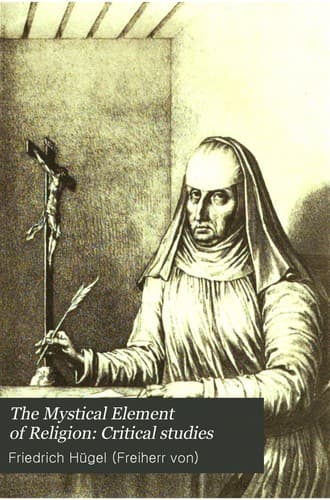
The Mystical Element of Religion, as studied in Saint Catherine of Genoa and her friends, Volume 2 (of 2)Hügel, Friedrich, Freiherr von
Religion
The Mystical Element of Religion, as studied in Saint Catherine of Genoa and her friends, Volume 2 (of 2)
Hügel, Friedrich, Freiherr von
Catherine, of Genoa, Saint, 1447-1510
Especially in Religion the Historical and Institutional (as Religion’s
manifestation in space and time), come down to us thus from the past
and surround us in the present, and either press in upon us with a
painful weight, or support us with a comforting solidity, thus giving
them many of the qualities of things physically seen and touched,
say, a mystery play or a vast cathedral. And, on the other hand,
the Rational, (whether Analytic or Synthetic,) and the Emotional
and Volitional Elements, whenever they are at all preponderant or
relatively independent of the other, more objective ones, are liable,
in Religion, to look quite exceptionally subjective,--and this in
the unfavourable sense of the word, as though either superfluous and
fantastic, or as dangerous and destructive.--And yet both that look of
the objective elements being, in Religion, more self-sufficing than
they appear to be in the ordinary psychic, or the artistic, or social,
or scientific life; and that impression conveyed by the subjective
elements in Religion, as being there less necessary or more dangerous
than elsewhere, are doubtless deceptive. These impressions are simply
caused by two very certain facts. Religion is the deepest and most
inclusive of all the soul’s energizings and experiences, and hence
all its constituents reveal a difference, at least in amount and
degree, when compared with the corresponding constituents of the more
superficial and more partial activities of the soul; and Religion,
just because of this, requires the fullest action and co-operation, the
most perfect unity, in and through diversity, of all the soul’s powers,
and all mere non-use of any of these forces, even any restriction to
the use of but one or two, is here, more readily and extensively than
elsewhere, detrimental both to the non-exercised and to the exercised
forces, and, above all, is impoverishing to the soul itself and to its
religion.
Public-domain text, read in full here on John Shaqi.
Reviews
Reviews
No reviews yet
Be the first to share your thoughts on this work.
Elsewhere in the archive
Join the Discussion
Join the discussion
Sign in to leave a comment or review.
Sign InorCreate an account