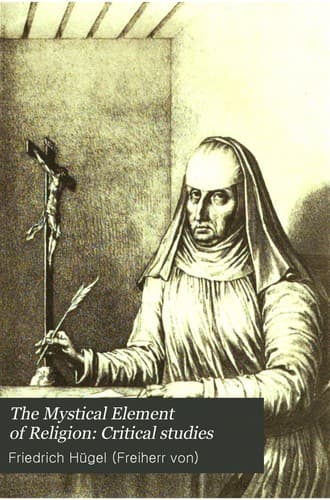
The Mystical Element of Religion, as studied in Saint Catherine of Genoa and her friends, Volume 2 (of 2)Hügel, Friedrich, Freiherr von
Religion
The Mystical Element of Religion, as studied in Saint Catherine of Genoa and her friends, Volume 2 (of 2)
Hügel, Friedrich, Freiherr von
Catherine, of Genoa, Saint, 1447-1510
Hence, here as elsewhere, but more than anywhere, our ideal standard
will be the greatest possible development of, and inter-stimulation
between, each and all of the religious elements, with the greatest
possible unity in the resulting organism. And yet,--in view of the
very greatness of the result aimed at, and of the fact that its even
approximate attainment can, even for any one age of the world, be
reasonably expected only from the co-operation of the differently
endowed and attracted races and nations, social and moral grades,
sexes, ages and individuals that make up mankind,--we shall not
only be very tolerant of, we shall positively encourage, largely
one-sided developments, provided that each keeps some touch with the
elements which itself knows not how to develop in abundance, and that
it considers its own self, and works out its own special gift and
_attrait_, as but one out of many variously gifted and apportioned
fellow-servants in the Kingdom,--as only one of the countless, mutually
complementary, individually ever imperfect, part-expressions of the
manifold greatness, of the rich unity of spiritual humanity as willed
by God, and of God Himself.
3. _Partial developments of the full Gospel Ideal._
Now in the New Testament we have a most instructive, at first sight
puzzling phenomenon, illustrative of the positions just taken up.
For here it is clear that, with regard to the distinction between
richly many-sided but as yet unarticulated religion, and comparatively
one-sided and limited but profoundly developed religion, we have two
considerably contrasted types of spiritual tone and teaching. We get
the predominantly “Objective” strand of life and doctrine, in the
pre-Pauline parts and in their non-Pauline echoes, _i.e._ in the
substance of the Synoptic tradition, and in the Epistles of St. James
and of St. Peter; and we find the predominantly “Subjective” strain
in the “Pauline” parts, St. Paul’s Epistles and the Joannine Gospel
and Letters.--And it has become more and more clear that it is the
pre-Pauline parts which give us the most immediately and literally
faithful, and especially the most complete and many-sided, picture of
Our Lord’s precise words and actions; whereas the Pauline parts give
us rather what some of these great creative forces were and became for
the first generations of Christians and for the most penetrating of
Christ’s early disciples and lovers. And yet it is the latter documents
which, at first sight, appear to be the deeper, the wider, and the more
profoundly spiritual; whereas the former look more superficial, more
temporal and local, and more simply popular and material.
Public-domain text, read in full here on John Shaqi.
Reviews
Reviews
No reviews yet
Be the first to share your thoughts on this work.
Elsewhere in the archive
Join the Discussion
Join the discussion
Sign in to leave a comment or review.
Sign InorCreate an account