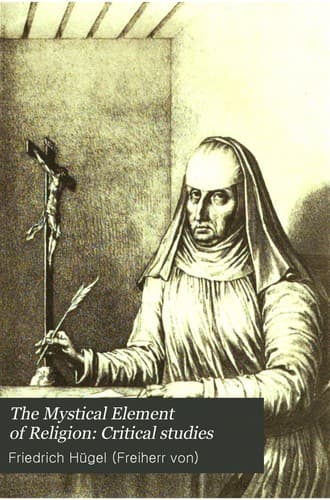
The Mystical Element of Religion, as studied in Saint Catherine of Genoa and her friends, Volume 2 (of 2)Hügel, Friedrich, Freiherr von
Religion
The Mystical Element of Religion, as studied in Saint Catherine of Genoa and her friends, Volume 2 (of 2)
Hügel, Friedrich, Freiherr von
Catherine, of Genoa, Saint, 1447-1510
And if Catherine is profoundly reflective, that reflection is, in its
general drift, deeply dualistic,--at least in the matter of body and
spirit. Their difference and incompatibility; the spirit’s fleeing of
the body; the spirit’s getting outside of it,--by ecstasy, for a little
while, even in this earthly life, and by this earthly body’s death, for
good and all; the body a prison-house, a true purgatory to the soul:
all this hangs well together, and is largely, in its very form, of
ultimately Neo-Platonist or Platonic origin.
1. _New Testament valuations of the body._
Now here is one of the promised instances of a double type--if not of
doctrine, yet at least of emotional valuation in the New Testament.
(1) In the Synoptist documents, (with the but apparent, or at least
solitary, exceptions, of Jesus’ Fasting in the Desert and of His
commendation of those who have made themselves eunuchs for the Kingdom
of Heaven),[113] we find no direct or acute antagonism to the body,
even to the average earthly human body, in the teaching and practice
of Our Lord. The Second Coming and its proximity do indeed, here
also, dwarf all earthly concerns, in so far as earthly.[114] This
background to the teaching and its tradition was, in course of time,
in part abstracted from, in part restated.--The entrance into life is
through the narrow gate and the steep way; only if a man turn, can he
enter into the Kingdom of God; only if he lose his soul, can he find
it:[115] this great teaching and example, as to life and joy being ever
reached through death to self and by the whole-hearted turning of the
soul from its false self to its true source, God: remains, in the very
form of its promulgation as given by the Synoptists, the fundamental
test and standard of all truly spiritual life and progress. But as to
the body in particular, Jesus here knows indeed that “the flesh is
weak,” and that we must pray for strength against its weakness:[116]
but He nowhere declares it evil--an inevitable prison-house or a
natural antagonist to the spirit. The beautiful balance of an unbroken,
unstrained nature, and a corresponding doctrine as full of sober
earnestness as it is free from all concentrated or systematic dualism,
are here everywhere apparent.
Public-domain text, read in full here on John Shaqi.
Reviews
Reviews
No reviews yet
Be the first to share your thoughts on this work.
Elsewhere in the archive
Join the Discussion
Join the discussion
Sign in to leave a comment or review.
Sign InorCreate an account