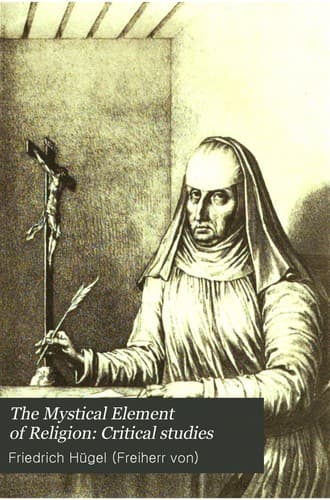
The Mystical Element of Religion, as studied in Saint Catherine of Genoa and her friends, Volume 2 (of 2)Hügel, Friedrich, Freiherr von
Religion
The Mystical Element of Religion, as studied in Saint Catherine of Genoa and her friends, Volume 2 (of 2)
Hügel, Friedrich, Freiherr von
Catherine, of Genoa, Saint, 1447-1510
Catherine herself, although delightfully free from the long scale of
mediations between the soul and God which forms one of the predominant
doctrines of the Areopagite, continues and emphasizes most of what is
common, and much of what is special to, all and each of these four
writers; she is a reflective saint, if ever there was one. And of her
too we shall have to say that she is great by what she possesses, and
not by what she is without: great because of her noble embodiment of
the reflective and emotional, the mystical and volitional elements
of Christianity and Religion generally. Religion is here, at first
sight at least, all but entirely a thought and an emotion; yet all
this thought and emotion is directed to, and occasioned by, an
abiding Reality which originates, sustains, regulates, and fulfils
it. And although this Reality is in large part conceived, in Greek
and specially in Neo-Platonist fashion, rather under its timeless and
spaceless, or at least under its cosmic aspect, rather as Law and
Substance, than as Personality and Spirit: yet, already because of the
strong influence upon her of the noblest Platonic doctrine, it is loved
as overflowing Love and Goodness, as cause and end of all lesser love
and goodness; and the real, though but rarely articulated, acceptance
and influence of History and Institutions, above all the enthusiastic
devotion to the Holy Eucharist with all its great implications, gives
to the whole a profoundly Christian tone and temper.
True, the Church at large, indeed the single soul (if we would take
such a soul as our standard of completeness) requires a larger
proportion of those crisp, definite outlines, of those factual,
historical, and institutional elements; a very little less than what
remains in Catherine of these elements, and her religion would be
a simple, even though deep religiosity, a general aspiration, not
a definite finding, an explicit religion. Yet it remains certain,
although ever readily forgotten by religious souls, especially by
theological apologists, that without some degree and kind of those
outgoing, apprehending, interpreting activities, no religion is
possible. Only the question as to what these activities should be, and
what is their true place and function within the whole religious life,
remains an open one. And this question we can study with profit in
connection with such a life and teaching as Catherine’s, which brings
out, with a spontaneous, childlike profundity and daring, the elemental
religious passion, the spiritual hunger and thirst of man when he is
once fully awake; the depths within him anticipating the heights above
him; the affinity to and contact with the Infinite implied and required
by that nobly incurable restlessness of his heart, which finds its rest
in Him alone Who made it.
II. DUALISTIC ATTITUDE TOWARDS THE BODY.
Public-domain text, read in full here on John Shaqi.
Reviews
Reviews
No reviews yet
Be the first to share your thoughts on this work.
Elsewhere in the archive
Join the Discussion
Join the discussion
Sign in to leave a comment or review.
Sign InorCreate an account