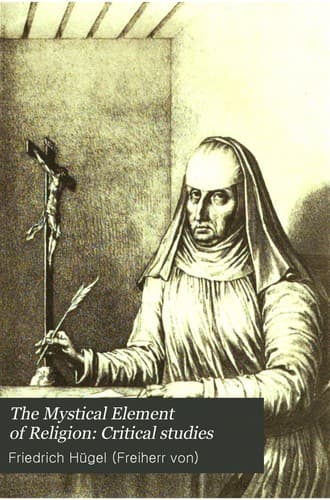
The Mystical Element of Religion, as studied in Saint Catherine of Genoa and her friends, Volume 2 (of 2)Hügel, Friedrich, Freiherr von
Religion
The Mystical Element of Religion, as studied in Saint Catherine of Genoa and her friends, Volume 2 (of 2)
Hügel, Friedrich, Freiherr von
Catherine, of Genoa, Saint, 1447-1510
It is very instructive to note, in this connection, how, after her four
years of directly penitential and ascetical practice, (an activity
which, even then, extended quite as much to matters of decentralization
of the self as of bodily mortification), her warfare is, in the first
instance, all but exclusively directed against the successive refuges
and ambushes of self-complacency and self-centredness. Thus there is
significance in the secondary place occupied, (even in the _Vita_, and
doubtless still more in her own mind), by the question of continence;
indeed her great declaration to the Friar indicates plainly her
profound concentration upon the continuous practice of, and growth in,
Love Divine, and her comparative indifference to the question of the
systematic renunciation of anything but sin and selfish attachments and
self-centrednesses of any kind. Her conception of sinners as “cold,”
even more than as dark or stained; of God as Fire, even more than
as Light; and of purity as indefinitely increasable, since Love can
grow on and on: all similarly point to this finely positive, flame-,
not snow-conception, in which purity has ceased to be primarily, as
with the Greeks, a simple absence of soiledness, even if it be moral
soiledness, and has become, as with the Synoptic teaching, something
primarily positive, love itself.
In her occasionally intense insistence upon herself as being all evil,
a very Devil, and in some of her picturings of her interior combat,
we get, on the other hand, echoes, not of Plato, nor again of the
Synoptist teaching, but of St. Paul’s “in my flesh there dwelleth no
good thing,” and of his combat between flesh and spirit.--Yet the evil
which she is thus conscious of, is not sensual nor even sensible evil
and temptation, but consists in her unbounded natural claimfulness and
intense inclination to sensitive self-absorption.--And this gives,
indeed, to these feminine echoes of St. Paul a certain thin shrillness
which the original tones have not got, standing there for the massive
experiences of a man violently solicitated by both sense and spirit.
But it leaves her free to note, as regards the flesh, the whole bodily
organism, (and this in beautiful sympathy with Our Lord’s own genially
fervent, homely heroic spirit), not its wickedness, but its weakness,
its short-livedness, and its appeal for merciful allowance to God,
“Who knows that we are dust.” Instead of a direct and pointed dualism
of two distinct substances informed by all but incurably antagonistic
principles, we thus get a direct conflict between two dispositions of
the soul, and a but imperfect correspondence between the body and that
soul.
Public-domain text, read in full here on John Shaqi.
Reviews
Reviews
No reviews yet
Be the first to share your thoughts on this work.
Elsewhere in the archive
Join the Discussion
Join the discussion
Sign in to leave a comment or review.
Sign InorCreate an account