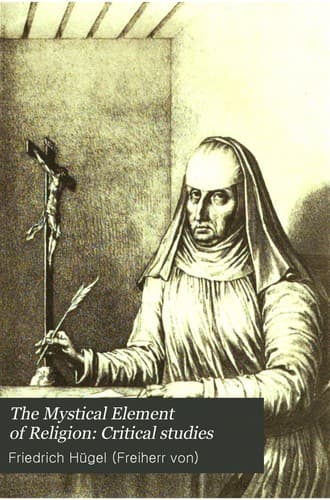
The Mystical Element of Religion, as studied in Saint Catherine of Genoa and her friends, Volume 2 (of 2)Hügel, Friedrich, Freiherr von
Religion
The Mystical Element of Religion, as studied in Saint Catherine of Genoa and her friends, Volume 2 (of 2)
Hügel, Friedrich, Freiherr von
Catherine, of Genoa, Saint, 1447-1510
(2) There is, indeed, no doubt that the very ancient association of the
ideas of Fire and of spiritual Purification goes back, in the first
instance, to the conception of the soul being necessarily stained by
the very fact of its connection with the body, and of those stains
being finally removed by the body’s death and cremation. We find
this severely self-consistent view scattered up and down Hellenic
religion and literature.[119] And even in Catherine the fire, a sense
of fever-heat, still seizes the body, and this body wastes away,
and leaves the soul more and more pure, during those last years of
illness.--Yet the striking identity, between that old cluster of ideas
and her own forms of thought, brings out, all the more clearly, the
immense road traversed by spirituality between the substance of those
ideas and the essence of this thought. For in her teaching, which
is but symbolized or at most occasioned by those physico-psychical
fever-heats, the Fire is, at bottom, so spiritual and so directly
busy with the soul alone, that it is ever identical with itself in
Heaven, Hell, Purgatory, and on earth, and stands for God Himself; and
that its effects are not the destruction of a foreign substance, but
the bringing back, wherever and as far as possible, of the fire-like
soul’s disposition and quality to full harmony with its Fire-source and
Parent, God Himself.
(3) Only the Prison-house simile for the body, as essentially an
earthly purgatory for the soul, must be admitted, I think, to remain
a primarily Platonic, not fully Christianizable conception; just as
the absence of all reference by her to the resurrection of the body
will have been, in part, occasioned by the strong element of Platonism
in her general selection and combination of ideas. Yet it would
obviously be unfair to press these two points too much, since, as to
the resurrection, her long illness and evidently constant physical
discomfort must, even of themselves, have disinclined her to all
picturing of an abiding, even though highly spiritualized, bodily
organization; and as to the likeness of her body to a prison and
purgatory of the soul, we are expressly told that it began only with
the specially suffering last part of her life.
3. _Dualism pragmatic, not final. Its limits._
Now, for this whole matter of the right conception as to the relations
of body and soul, it is clear that any more than partial and
increasingly superable antagonism between body and spirit cannot be
accepted.
Public-domain text, read in full here on John Shaqi.
Reviews
Reviews
No reviews yet
Be the first to share your thoughts on this work.
Elsewhere in the archive
Join the Discussion
Join the discussion
Sign in to leave a comment or review.
Sign InorCreate an account