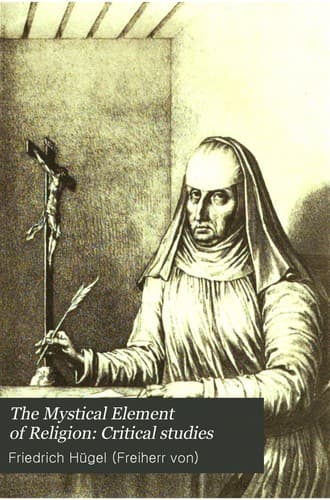
The Mystical Element of Religion, as studied in Saint Catherine of Genoa and her friends, Volume 2 (of 2)Hügel, Friedrich, Freiherr von
Religion
The Mystical Element of Religion, as studied in Saint Catherine of Genoa and her friends, Volume 2 (of 2)
Hügel, Friedrich, Freiherr von
Catherine, of Genoa, Saint, 1447-1510
(4) No man can become, or is proclaimed to have become, a Christian
saint, who has not thus achieved a profound spiritualization and
unification of a more or less recalcitrant material and multiplicity.
In some cases, it is the unity and detachment that greatly predominate
over the multiplicity and attachment,--as, say, in the Fathers of the
Desert. In other cases, it is the variety and attachment that strikes
us first of all,--as, for instance, in Sir Thomas More and Edmund
Campion. And, in a third set of cases, it is the depth of the unity and
detachment, in the breath of the variety and attachment, which is the
dominant characteristic, so with St. Paul and St. Augustine. Catherine
herself belongs, for her great middle period, rather to the third
group than to either of the other two; only during her penitential
period and her last long illness does she clearly belong to the group
of intensely detached and unified saints.--It is evidently impossible
in such a matter to do more than insist upon the necessity of both
movements; upon the immensely fruitful friction and tension which
their well-ordered alternation introduces into the soul’s inner life;
and upon the full ideal and ultimate measure for the complete and
perfected man, humanity at large, being a maximum of multiplicity and
attachment permeated and purified by a maximum of unity and detachment.
The life which can englobe and organize both these movements, with
their manifold interaction, will have a multitude of warm attachments,
without fever or distraction, and a great unity of pure detachment,
without coldness or emptiness: it will have the, winning because rich,
simplicity and wondrous combination of apparent inevitableness and of
seeming paradox furnished by all true life, hence exhibited in its
greatest fulness by the religious life which, at its deepest, is deeper
any other kind of life.
III. QUIETUDE AND PASSIVITY. POINTS IN THIS TENDENCY TO BE CONSIDERED
HERE.
Public-domain text, read in full here on John Shaqi.
Reviews
Reviews
No reviews yet
Be the first to share your thoughts on this work.
Elsewhere in the archive
Join the Discussion
Join the discussion
Sign in to leave a comment or review.
Sign InorCreate an account