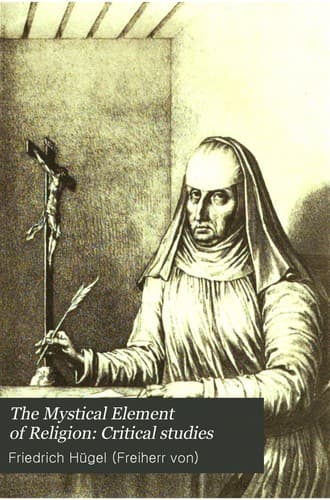
The Mystical Element of Religion, as studied in Saint Catherine of Genoa and her friends, Volume 2 (of 2)Hügel, Friedrich, Freiherr von
Religion
The Mystical Element of Religion, as studied in Saint Catherine of Genoa and her friends, Volume 2 (of 2)
Hügel, Friedrich, Freiherr von
Catherine, of Genoa, Saint, 1447-1510
We have inevitably somewhat anticipated another matter, in which
Catherine shows all the true Mystic’s affinities: the craving for
simplification and permanence of the soul’s states,--her practice
and teaching as to Quietude and Passivity. Pushed fully home, this
tendency involves four closely related, increasingly profound,
convictions and experiences. Utter unification of the soul’s functions,
indeed utter unity of its substance: _i.e._ the soul does one single
thing, and seems to do it by one single act; itself is simply one, and
expresses itself by one sole act. Passivity of the soul: _i.e._ the
soul does not apparently act at all, it simply _is_ and receives--it
is now nothing but one pure immense recipiency. Immediacy of contact
between the soul and God: _i.e._ there seems to be nothing separating,
or indeed in any way between, the soul and God. And, finally, an
apparent coalescence of the soul and God: _i.e._ the soul _is_ God, and
God _is_ the soul.--Only the first two points, and then the closely
related question of Pure Love, shall occupy us here; the last two
points must stand over for our penultimate chapter.
1. _Distinction between experiences, their expression, and their
analysis._
We have already studied the psycho-physical occasions, concomitants,
and embodiments of Catherine’s keen desire for, and profound experience
of, spiritual unification and passivity; and we can have no kind of
doubt as to the factual reality and the practical fruitfulness of the
state so vividly described by her. Here we have only to inquire into
the accuracy of the analysis and terminology effected and employed by
her, in so far as they seem to claim more than simply to describe the
soul’s own feeling and impression as to these states thus experienced
by itself. We have then to consider the nature and truth of what can
roughly be styled Quietism and Passivity.
Now here especially will it be necessary for us carefully to
distinguish between the direct experiences, impressions, and
instinctive requirements of the soul,--here all souls, in precise
proportion to their depth and delicacy of holiness and of
self-knowledge are our masters, and furnish us with our only materials
and tests; and, on the other hand, the implications and analysis of
these states, as, in the first instance, psychological, and then as
requiring elucidation with regard to their ontological cause and
reality by means of a religious philosophy,--here, psychology, and
religious philosophy, especially also the discriminations and decisions
of theologians and Church authorities as expressive of these ultimate
questions, will be our guides.[122]
Public-domain text, read in full here on John Shaqi.
Reviews
Reviews
No reviews yet
Be the first to share your thoughts on this work.
Elsewhere in the archive
Join the Discussion
Join the discussion
Sign in to leave a comment or review.
Sign InorCreate an account