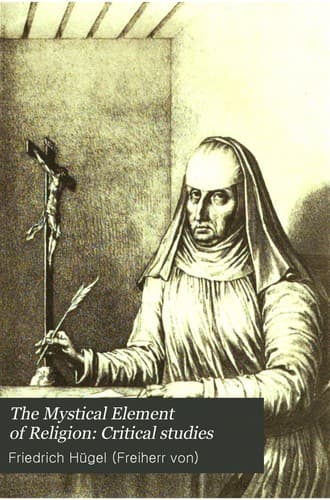
The Mystical Element of Religion, as studied in Saint Catherine of Genoa and her friends, Volume 2 (of 2)Hügel, Friedrich, Freiherr von
Religion
The Mystical Element of Religion, as studied in Saint Catherine of Genoa and her friends, Volume 2 (of 2)
Hügel, Friedrich, Freiherr von
Catherine, of Genoa, Saint, 1447-1510
(1) If we start from the history of the nomenclature which, (though
present only partially in Catherine’s sayings, for she nowhere uses the
term “passivity”), runs, with however varying a completeness, right
through the Christian Mystics more or less from the first, we shall
find that it consists, roughly, of three stages, and, throughout,
of two currents. There is the Pre-Pauline and Pre-Philonian stage;
the stage of Paul, Philo, and John, through Clement and Origen,
on to Gregory of Nyssa and St. Augustine; and the stage from the
Pseudo-Dionysius onward, down to Nicolas of Coes inclusive, and which,
to this hour, still largely influences us all.--And there are the two
currents. The one tends so to emphasize the sense and reality of the
soul’s simple receptivity, and of what the soul receives at such,
apparently, purely receptive times, as to ignore, or even practically
deny, the undeniable fact that this very receptivity is, inevitably,
an act of its own. Its decisive terms are Passivity, Fixedness,
Oneness. The other current realizes that Grace does not destroy,
violate, or supplant Nature, either entirely or in part, but that it
awakens, purifies, and completes it, so that every divine influx is
also ever a stimulation of all the good and true energy already, even
though latently, present in the soul. And its characteristic terms are
“Action” (as distinguished from “Activity”), Growth, Harmony.
(2) And we should note with care that these two currents are not simply
Heathen and Christian respectively. For if that great, indeed all but
central, term and conception of “Action” has been wisely generalized
by most Christian Mystics, as the truly Christian substitute for the
strongly Neo-Platonist term “Passivity”: that term and conception of
“Action” was first fixed and elucidated by Aristotle, who, as Mr.
Schiller well puts it, “has packed into his technical term ‘Energeia,’
and especially into the combination ‘Unmoving Energy,’ all that
was most distinctive, most original, most fundamental, and most
profound in his philosophy”;[123] whilst the second term, “Passivity,”
goes on figuring in Christian Mystics and Mystical Theologies--(in
spite of its demonstrably dangerous suggestions and frequently
scandalous history)--because the religious, especially the Christian,
consciousness requires a term for the expression of one element of all
its deepest experiences, that character of “giveness” and of grace, of
merciful anticipation by God, which marks all such states, in exact
proportion to their depth and to the soul’s awakeness.
Public-domain text, read in full here on John Shaqi.
Reviews
Reviews
No reviews yet
Be the first to share your thoughts on this work.
Elsewhere in the archive
Join the Discussion
Join the discussion
Sign in to leave a comment or review.
Sign InorCreate an account