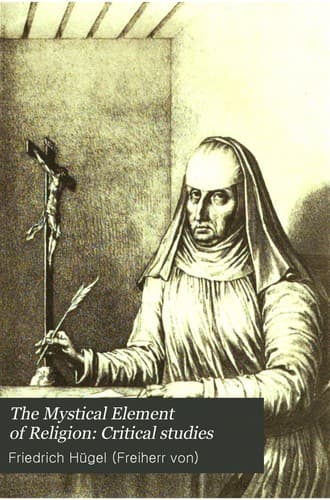
The Mystical Element of Religion, as studied in Saint Catherine of Genoa and her friends, Volume 2 (of 2)Hügel, Friedrich, Freiherr von
Religion
The Mystical Element of Religion, as studied in Saint Catherine of Genoa and her friends, Volume 2 (of 2)
Hügel, Friedrich, Freiherr von
Catherine, of Genoa, Saint, 1447-1510
(1) The neglect or even contempt of vocal prayer, and of the historical
and institutional elements of religion, at least in the case of
more advanced souls, is one of these abuses.--Now it is true, and
Catherine has been a striking instance, that the proportion of all
these different elements towards one another vary, and should vary,
considerably between soul and soul, according to the _attrait_ and
degree of advance of each; that the soul’s most solid advance is in the
direction of an ever-deepened spiritual devotedness, and not in that of
a multiplication of particular devotions; that the use of even the more
central of those elements and means may, for souls called to the prayer
of Quiet, become remarkably elastic and largely unmethodized; and that,
for such souls (and, in various degrees and ways, sooner or latter, for
perhaps most other souls), a prayer of peacefully humble expectation
and of all but inarticulate, practically indescribable, brooding of
love, and of dim, expansive trust and conformity is possible, sometimes
alone possible, and is proved right and useful, if it leaves them
strengthened to act and to suffer, to help and to devote themselves to
their fellows, to Christ, and to God.
But it remains equally true, even for these as for all other souls,
that the historical and institutional elements must ever remain
represented, and sufficiently represented; indeed the persistence in
these elements of religion will be one of the chief means for avoiding
delusion. We have St. Teresa’s experience and teaching here, as a truly
classical instance. And if the prayer of Quiet will give a special
colour, depth, and unity to those more contingent-seeming practices,
these practices will, in return, give a particular definiteness,
content, and creaturely quality to that prayer. And thus too the
universally and profoundly important union and interchange with souls
of other, equally legitimate, kinds and degrees of spirituality will
be kept up. Only the sum-total of all these souls, only the complete
invisible Church, is the full Bride of Christ; and though the souls
composing her may and should each contribute a varying predominance of
different elements, no soul should be entirely without a certain amount
of each of these constituents.
Public-domain text, read in full here on John Shaqi.
Reviews
Reviews
No reviews yet
Be the first to share your thoughts on this work.
Elsewhere in the archive
Join the Discussion
Join the discussion
Sign in to leave a comment or review.
Sign InorCreate an account