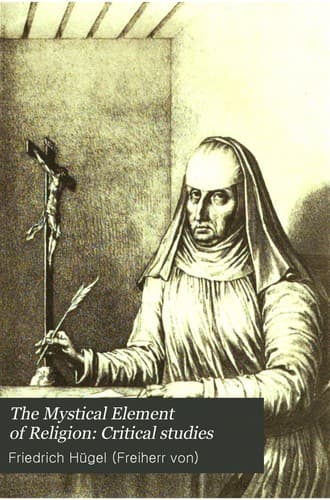
The Mystical Element of Religion, as studied in Saint Catherine of Genoa and her friends, Volume 2 (of 2)Hügel, Friedrich, Freiherr von
Religion
The Mystical Element of Religion, as studied in Saint Catherine of Genoa and her friends, Volume 2 (of 2)
Hügel, Friedrich, Freiherr von
Catherine, of Genoa, Saint, 1447-1510
(2) Another abuse is the neglect, contempt, or misapplied fear
of not directly religious occupations and labours which, however
otherwise appropriate or even necessary to this soul’s growth and
destination, tend to disturb its quiet and to absorb a part of its
time and attention. Here it is doubtless true that the other elements
of religion are also all more or less apprehensive and jealous with
regard to actual, or even only possible, non-religious rival interests.
And it is certain that they are all right in so far as that a certain
interior leisureliness and recollection, a certain ultimate preference
for the spiritualizing religious force of the soul as against the
materials, non-religious and other, which that force is to penetrate,
are necessary to the soul that would advance.
But the fear that characterizes the Historical and Institutional
elements is rather a fear, respectively, of error and of disobedience
and singularity, whereas on the part of the Mystical element it is a
fear of distraction and absorption away from the _Unum Necessarium_ of
the soul. Perhaps even among the Canonized Mystics there is none that
has more impressively warned us, both by word and example, against
this insidious danger, than the distinguished Platonist scholar and
deep spiritual writer, Père Jean Nicolas Grou, who, right through the
long mystical period of his life, alternated his prayer of Quiet with
extensive and vigorous critical work on the Graeco-Latin classics,
and whose practice only wants further expansion and application,
(according to the largely increased or changed conditions of such not
directly religious work), in order to bear much fruit, not only for
criticism and science, but, (by the return-effect of such occupations
upon the soul’s general temper and particular devotional habits), for
spirituality itself. But we must return to this point more fully in our
last chapter.
Public-domain text, read in full here on John Shaqi.
Reviews
Reviews
No reviews yet
Be the first to share your thoughts on this work.
Elsewhere in the archive
Join the Discussion
Join the discussion
Sign in to leave a comment or review.
Sign InorCreate an account