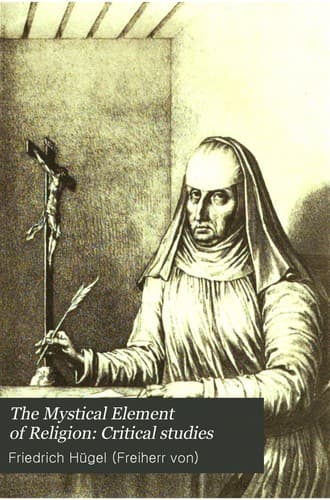
The Mystical Element of Religion, as studied in Saint Catherine of Genoa and her friends, Volume 2 (of 2)Hügel, Friedrich, Freiherr von
Religion
The Mystical Element of Religion, as studied in Saint Catherine of Genoa and her friends, Volume 2 (of 2)
Hügel, Friedrich, Freiherr von
Catherine, of Genoa, Saint, 1447-1510
Quietism, then, has undoubtedly isolated and further exaggerated
certain explanatory elements of the older Mysticism which, even there,
were largely a weakness and not a strength; has thus underrated and
starved the Particular, Visible, Historical, Institutional constituents
of Religion; and has, indeed, misunderstood the nature of true Unity
everywhere. Yet the very eagerness with which it was welcomed at
the time,--in France and Italy especially,--and this, not only as a
fashion by the _Quidnuncs_, but as so much spiritual food and life by
many a deeply religious soul; and the difficulty, and not infrequent
ruthlessness of its suppression, indicate plainly enough that, with
all its faults and dangers, it was divining and attempting to supply
certain profound and abiding needs of the soul. I take these needs to
be the following four.
(1) Man has an ineradicable, and, when rightly assuaged, profoundly
fruitful thirst for Unity,--for Unification, Synthesis, Harmonization;
for a living System, an Organization both within and without himself,
in which each constituent gains its full expansion and significance
through being, and more and more becoming, just _that_ part and
function of a great, dynamic whole; a sense of the essential and
ultimate organic connection of all things, in so far as, in any degree
or form, they are fair and true and good. And this sense and inevitable
requirement alone explain the surprise and pain caused, at first, to
us all, by the actual condition of mutual aloofness and hostility,
characteristic of most of the constituents of the world within us, as
of the world around us, towards their fellow-constituents. A truly
atomistic world,--even an atomistic conception of the world,--of life,
as a collection of things one alongside of another, on and on, is
utterly repulsive to any deeply religious spirit whose self-knowledge
is at all equal to its aspirations.--No wonder, then, if the Quietists,
haunted by the false alternative of one such impenetrable atom-act or
of an indefinite number of them, chose the One Act, and not a multitude
of them.
Public-domain text, read in full here on John Shaqi.
Reviews
Reviews
No reviews yet
Be the first to share your thoughts on this work.
Elsewhere in the archive
Join the Discussion
Join the discussion
Sign in to leave a comment or review.
Sign InorCreate an account